The years speed by, marked by our annual trip to Rocky Mountain National Park, where my family visits the same weekend of every year. We go in the winter, strapping on our snow shoes, a plethora of winter gear, and a deep breath ready to exhale.
We chose to head to Sprague Lake, where we often end up. It’s not quite as crowded as Bear Lake, farther up the road, and not as long of a drive to the trail head.
There’s been a lot of snow this year. Some years we don’t even need our snowshoes, the snow base is dotted with patches of gravel. The wind is furious as we use our numb and cracked fingers to strap on our snowshoes. We make it into the shelter of trees, which keep out the wind and beckon us into their comforting embrace. I love being in the forest; the trees give me a kind of peace I don’t experience many other places. I exhale as we begin the slight uphill climb.
Sprague Lake is located at the parking lot of the trail head. Unlike other trails, this is not a destination hike. The trail connects to many other trails, the routes of possibilities almost endless. We continue on, stopping to take photos and catch our breath. The trail is being lightly traveled today, the stillness and the quietness filling our souls. The sun was out when we began, but the clouds have steadily built.
We come to a fork in the trail and decide to turn towards Glacier Basin. Light snow begins to fall, trickling down playfully. It feels magical, like Christmas is happening again, although it’s February. As the snow begins to pick up speed we make our back down the trail, thankful for another year to experience this beautiful place.
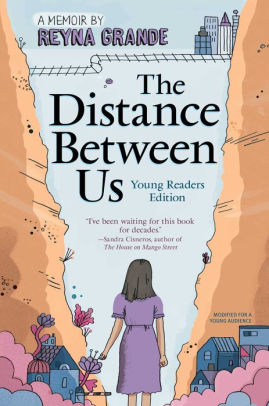
Title: The Distance Between Us, Young Reader’s Edition
Author: Reyna Grande
Awards: Honor Book Award for the Americas Award for Children’s and Young Adult Literature, Eureka! Honor Awards, International Literacy Association Children’s Book Award
Book Focus: Multicultural, Partial Autobiography
Reyna Grande was born in Iguala, Mexico and lived there until she was nine years old. Her parents left her and her siblings in Mexico with relatives while they sought work and saved money in the United States. Her family was separated for many years until she and her siblings also migrated to the United States. She writes about the struggles of migrant children both before and after migration in her books. Rayna graduated from UCSC with a degree in creative writing and from Antioch University with an M.F.A. in creative writing and is an award winning author and speaker.
The Distance Between Us is a partial autobiographical memoir written by Reyna Grande. She details the early years of her life while she was living in Iguala, Mexico. Her family lived in extreme poverty with little prospects for improvement. Her father left to seek work in the United States when Reyna was two years old, and her mother followed a few years later. Being separated from her parents was traumatic for her and her siblings, and living with relatives was not easy. After her mother returns and leaves again a few times, Reyna and her siblings made the harrowing journey to cross the border into the United States with their father. She writes about adjusting to a new country, her family’s personal struggles, and her path to becoming an author.
The Distance Between Us plays two important roles as part of multicultural literature, depending on the cultural group of the reader. Tunnel et al. stated that multicultural literature can “foster an awareness, understanding, and appreciation of people who seem at first glance different than the reader” and can “present a positive and reassuring representation of a reader’s own cultural group” (2016, p. 200). The Distance BetweenUs may connect with Latino children who migrated or have family or friends that migrated. Latino readers may also connect with the cultural elements of the book, even if they do not have any personal connections to migration. Grande writes in a relatable, easy style that students will connect to. She describes her traumatic experiences of running across the border, being abused by family members, and being left by her parents in a way that is realistic and invokes empathy. Yet, despite so much adversity, we see Reyna as a strong and determined, and sometimes fearful, girl.
Tunnel et al. stated that, “Cultural details need to be represented accurately in literature” (2016, p. 203). The Distance Between Us contains many details to add to the realism of the book. This book is unique because it is a memoir, so the details are authentic to the author’s experience. There is a scene in which Reyna’s grandfather is cutting off her hair because it is infested with lice.
“I jerked around, crying and yelling for Mami to come. I hated myself for being so weak the night before, when I’d torn the towel off. Tears rolled down my face, and I cried for my hair, because I loved my hair. It was the only beautiful thing I had, curls so thick that women in the street would stop and touch them and tell Mami, ‘What lovely hair your daughter has. She looks like a doll,’ and Mami would smile with pride.”
The Distance Between Us, p. 23.
We can feel Reyna’s distress and understand that her hair was a connection to her mother. The details in the writing make us feel like we are there, making this a culturally specific children’s book (Tunnel et al., 2016, p. 204). Grande writes about Quinceaneras, Mexican myths like La Llorona who roams the canals, and uses Spanish dialect to gain authenticity. Later, after Reyna has been in the United States for several years, she returns to Mexico to visit. At the point she knows that she is not fully accepted as Mexican any longer. She has lost some of her Spanish and she is very different in the way she thinks and acts and dreams now. This feeling of not quite fitting in in either culture, can be understood by many people.
There are many ways that this novel can be used to prompt critical literacy skills. Students can consider what it might be like to be separated from their parents, or to feel that you don’t fit into a group. This story may disrupt the common place for some students who have never thought about parents leaving their children. There are many thought-provoking discussions to be had regarding Reyna’s parents. Should the parents have left Iguala in search of money, or would it have been better for their family if they had stayed? Would it have been better to live in such poverty? Would the parents have stayed together in Mexico? Why did the parents stay away for so long? Why couldn’t they have brought the children with them? Why did Reyna’s mom leave a second time? Why does her mom say they can’t bring Betty with them to the United States? It is interesting to see varying perspectives of the characters. Why does Papi act the way he does? Why does Mila act the way she does? Why do her grandmother and Elida treat Reyna and her siblings the way they do? Also, there are many current events occurring in our country that connects to the immigration issue in a sociopolitical way. There many families being separated at the border and being held in deplorable conditions. The DREAM act which would grant residency status to undocumented minors faces strong opposition. Students may feel compelled to take action to provide relief for immigrants or to make their voices heard through their legislators and senators.
The Distance Between Us contains many writing elements that elevate the telling of the story. I love the description of Abuela Evila’s house as they approach it to stay while their parents are gone. There is a sense of foreshadowing and foreboding. “Abuela Evila’s house sat at the bottom of the hill. It was a small adobe house painted white with a terra-cotta tile roof. Bougainvillea climbed up on one side. The vine, think with red flowers, made the house look as if it were bleeding” (p. 3). The reader is drawn in by this description, and can feel like we are standing in front of Abuela Evila’s house. Grande also makes use of figurative language to show us what is happening and describe the characters. She described Abuela Evila as, “bent to the ground, as if she were carrying an invisible sack of corn” (p. 4). The road on their bus ride is described as “the broken white lines running through it like stitches” (p. 127).
References
Tunnell, M. O., Jacobs, J. S., Young, T. A., & Bryan, G. (2016). Children’s literature, briefly (6th ed.). Upper Saddle River, NJ: Pearson.
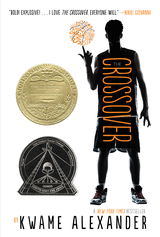
Book Focus: Poetry, Contemporary Realistic Fiction
Kwame Alexander was born in Manhattan, NY and wrote his first poem when he was twelve years old. He has written 32 books and won many awards, such as the Newbery, The Coretta Scott King Author Award, and the Lee Bennett Hopkins Poetry Award. He has said that he writes in poetry because it’s accessible and relatable. Kwame Alexander is also a is popular speaker at schools, libraries, and conferences.
The Crossover is the story, told through poetry, of Josh and Jordan Bell, twin middle school aged boys. Jordan, who goes by the nickname JB and Josh, whose nickname is Filthy McNasty, are stars of their school’s basketball team. Their father was a professional basketball player whose career was cut short by injury, and their mom is the assistant principal of their middle school. Their story takes the reader through the events of JB’s first girlfriend, a major fight between the boys with serious consequences, and the uncertain health of their father. Through these events the boys recognize the power of family, community, and hope.
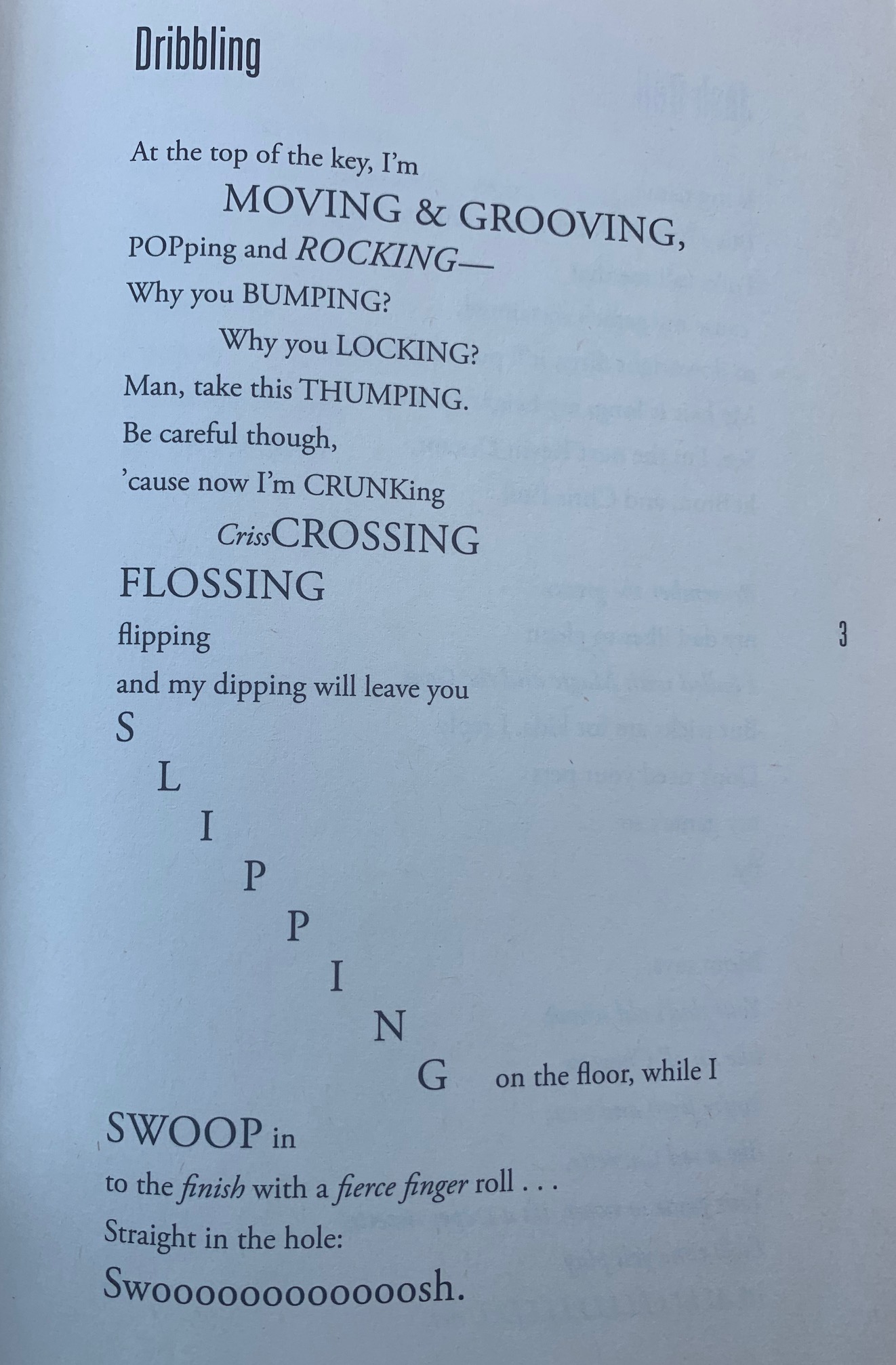
The Crossover is a novel written through poetry, which could be called a verse novel, since it could be classified a contemporary realistic fiction novel written through poetry. As a novel, this is narrative poetry, but it also conforms to free verse poetry, using some “rhythm and cadence for its poetic form” (Tunnel et al, 2016, p. 99). For example, in describing a playoff game, Alexander wrote, “Sliding and Gliding into rare air, lighting up the sky and the scoreboard” (p. 182). Although The Crossover is not a concrete poem, on page three, the font and print takes shape, which adds interest and movement to the text.
Kwame Alexander uses many writing elements to bring his story to life. Vocabulary plays a large role in TheCrossover. Throughout the book Josh uses words that are important to the text and are defined for the reader. For example, the word crossover is used and defined as “a basketball move in which a player dribbles the ball quickly from one hand to the other” (p.29). These definitions are followed by examples of how the word relates the events in the book. Other words defined in the book include calamity, patellatendinitis, and pulchritudinous. These words are examples of precise vocabulary and also expose the reader to new, interesting words.
Another writing element used in this book is figurative language, which “conveys meaning quickly and with emotional intensity” (Tunnel et al. 2016, p. 27). Josh’s dad said to him, “Filthy, talking to your brother right now would be like pushing water uphill with a rake, son” (p. 91). I also appreciate the use of alliteration, which adds energy to the text. Josh describes, ” Up by sixteen with six seconds showing, JB smiles, then struts side steps stutters spins, and sinks a sick sliding sweeeeeeeeeet seven foot shot” (p. 94).
Dialogue is not used in the traditional sense in The Crossover. There is not much use of punctuation or long conversations between characters, but yet there is interesting dialogue. The dialogue is written in italics to distinguish it from the rest of the text. The brevity of the dialogue emphasizes the meaning. After Josh throws the ball so hard at JB during a game that he is hurt and bleeding, Josh talks with his mom:
You’re twins, not the same person. But that doesn’t mean he has to stop loving me.
Your brother will always love you, Josh. I guess.
Boys with no discipline end up in prison. Yeah, I heard you the first time.
Don’t you get smart with me and end up in more trouble. Why are you always trying to scare me?
We’re done. Your dad is waiting for you.
Okay, but what about the consequences?
You’re suspended.
From school?
From the team.
…….
–The Crossover, p. 140
The poetry in The Crossover is an example of music in language. Tunnel et al. stated, “The sounds of words increase the appeal and strength of a story as they blend together , create emphasis, repeat tones, establish patterns, provide cadence, and add variety” (2016, p. 28). The part of the book when Josh is playing basketball with his dad and then his dad has a heart attack has significant cadence, pattern, and tone. Alexander wrote,
Crowd wild
Dad drives
Steps stride
Runs fast
Hoop bound
Stutter steps
Let loose
Screams loud
Stands still
Breath short
More sweat Grabs chest
Eyes roll
Ball drops
I scream
“Help, please”
The Crossover, p. 195
Many of the insights in TheCrossover come in the form of “Basketball Rules,” which occur throughout the book. Rule #3 stated, “Never let anyone lower your goals. Others’ expectations of you are determined by their limitations of life” (p. 66). Rule #5 stated, “When you stop playing your game you’ve already lost” (p. 93). These rules, or insights, apply to both basketball and life issues. After being yelled at by JB’s girlfriend, Josh waits to see if his brother will defend him. After no response from him Josh said, “Sometimes it’s the things that aren’t said that kill you” (p. 156).
The Crossover can also be considered in the category of multicultural literature. Tunnel et al. stated, “Literature can be one of the most powerful tools for combating the ignorance that breeds xenophobic and judgmental behaviors” (2016, p. 202). The characters and story told in The Crossover are believable and engaging to the reader, who may or may not be from the cultural group that the book centers on. The reader becomes invested in Josh’s story, wondering what will happen with his relationship with his twin brother and what will happen with the father’s health. The use of nicknames for Josh and Jordan, as well as the girlfriend who is called Sweet Tea by Josh, make the characters feel like real people. The emotions that the characters express also aids in their credibility. At the end of the championship game Josh realizes his father is dying. He said, “Before I know it, the whistle blows, the ball in my hand, the clock running down, my tears running faster” (p. 220). We feel the loss of his father along with Josh.
The Crossover could be considered a culturally specific children’s book (Tunnel at al. 2016). This book is about an African American family and the details mentioned rend it authentic. Josh’s dreadlocks are important to him, and when some of them get cut off by JB, Josh is devastated. This, in fact, is part of why Josh throws the ball so hard at JB later in the book. There are also details like musical artists, shoe brands, and language style that add to the realism. Author authenticity is also present, because the book was written by member of the African American culture.
References
Tunnell, M. O., Jacobs, J. S., Young, T. A., & Bryan, G. (2016). Children’s literature, briefly (6th ed.). Upper Saddle River, NJ: Pearson.
Awards: International Latino Book Award, Best Bilingual Children’s Book, Americas Book Commended Title
Book Focus: Multicultural, Realistic Contemporary Fiction
Rene Colato Lainez was born in El Salvador where he lived with his family and spent time with his uncle, a well known author there. When El Salvador became involved in a civil war, he and his father left and made their way to the United States. At one point in their journey he was left alone while his father worked. He began writing at that time, and continued to write in high school and college. He is now an award winning author if children’s books with a multicultural focus, helping Latino American children see themselves in stories that reflect their lives.
Joe Cepeda is a Los Angeles native who graduated from Long Beach State with a degree in Illustration. He had illustrated over 30 books, illustrates for magazines and other publications, and speaks at schools. Joe Cepeda is president of the Society of Illustrators of Los Angeles.
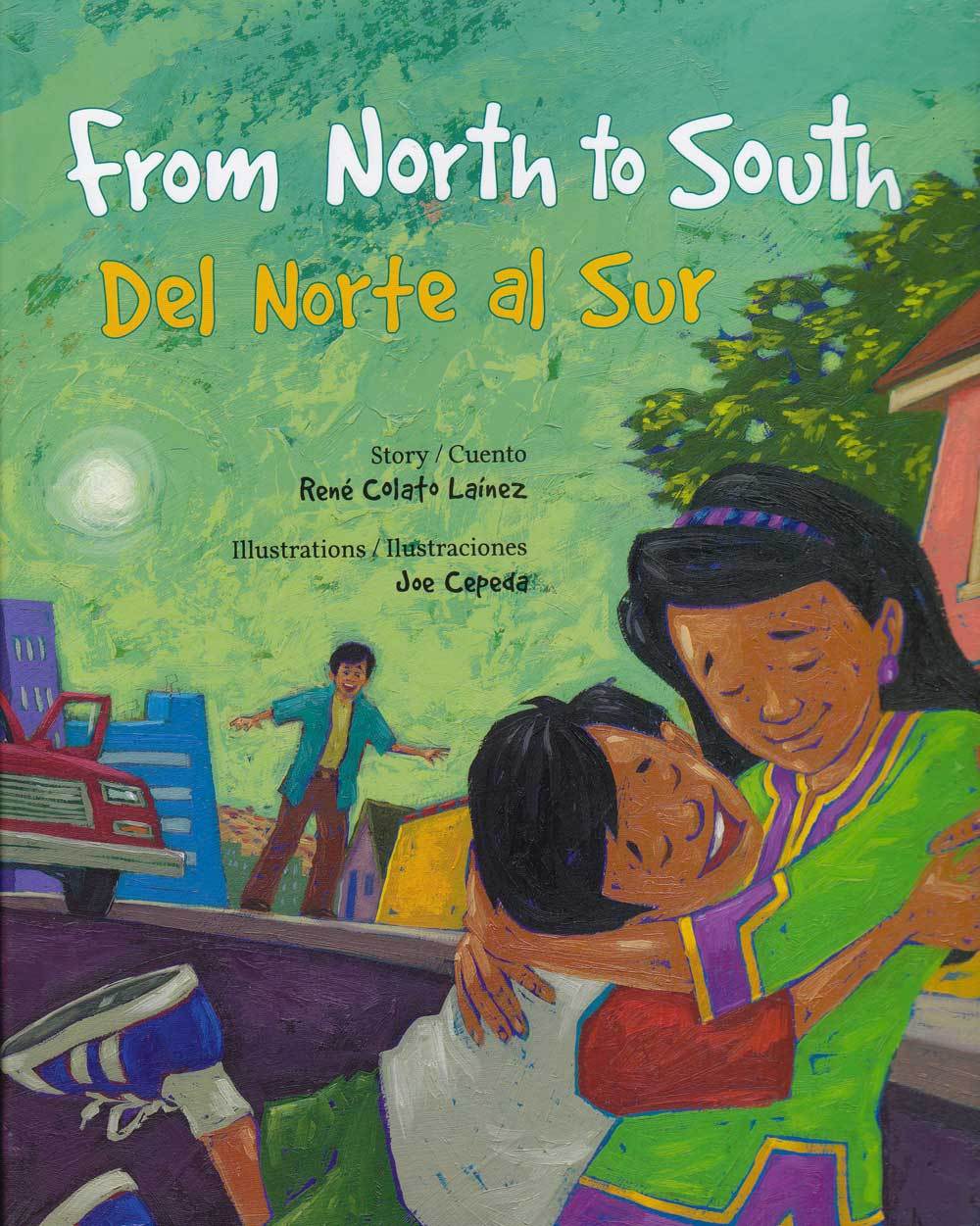
From North to South is the story of a young boy, Jose, who lives in California with his parents. One day his Mama is deported back to Mexico, and Jose and his Papa are separated from her. Jose is nervous and excited about visiting his Mama in Mexico, but reassured when he sees her again and helps her settle in to her temporary home. From North to South is full of the love of family and the hope of being together again.
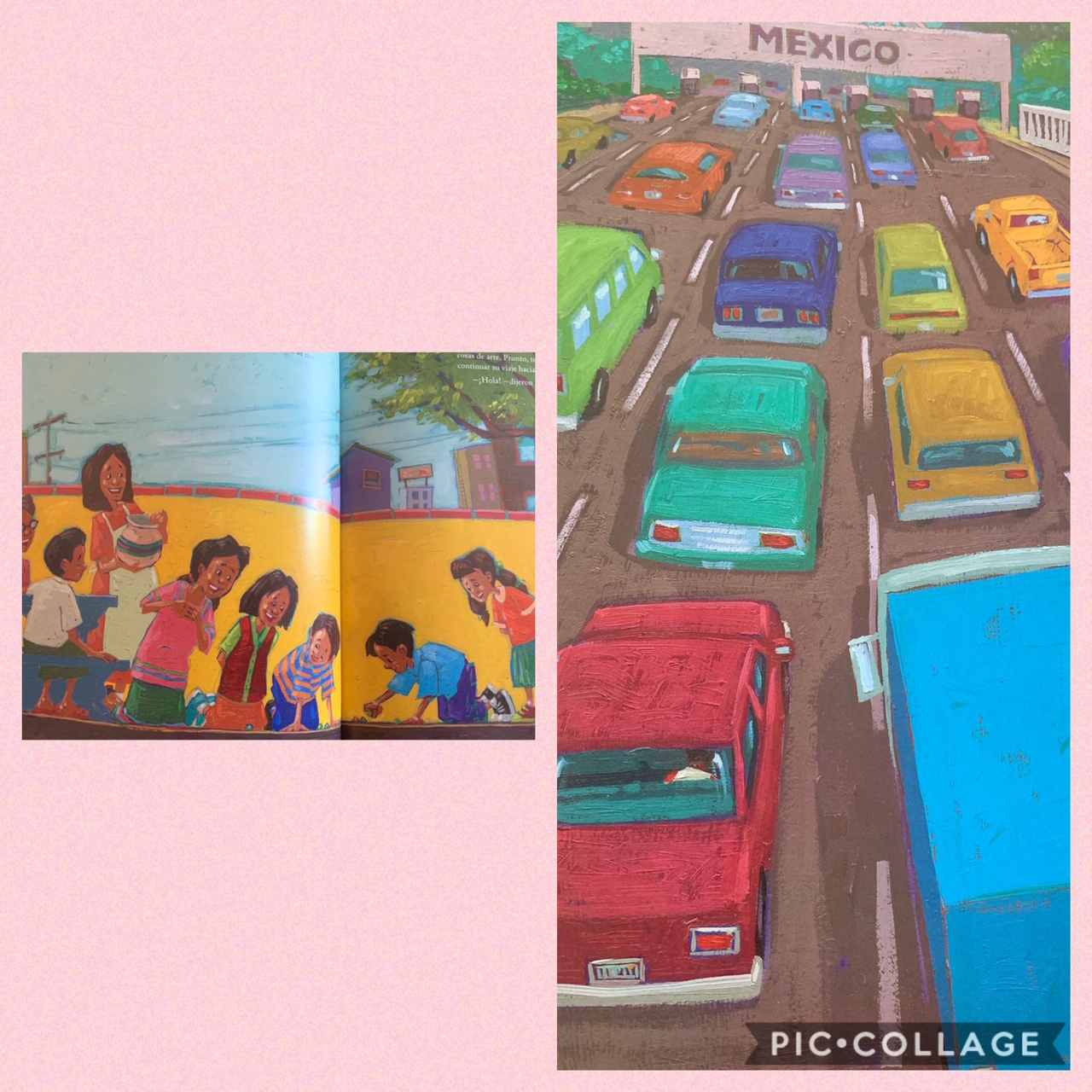
From North to South is an example of a multicultural book. Tunnel et al. stated that, “Well-written books that express multicultural themes or are international in their origins may have a profound effect on readers, prompting a global outlook as well as an understanding that members of the human family have more similarities than differences” (2016, p. 201). This book gives the reader the perspective of Jose, a young boy whose mother has been deported. Jose is sad, just as any child would be sad to be separated from his or her mother, yet From North to South uses cultural details to bring the reader into the setting of the story. There are Spanish words and names throughout the book, they bring Mama her favorite pan dulce, we see cars passing through immigration at the border, and Jose meets other children who are separated from their mothers. When Jose and his father visit his mother in Tijuana, they see children on the streets selling shoe shines and bubble gum. From North to South normalizes deportation and immigration issues, while remaining hopeful and reassuring. Jose said, “I dreamt that Mama had the right papers and we crossed the border together. Above our house, the sky filled with fireworks and I knew that all the other children would see their parent, too” (p. 32). Finally, From North to South has cultural authenticity. Rene Colato Lainez immigrated to the United States as a child and drew from that experience as inspiration for this book.
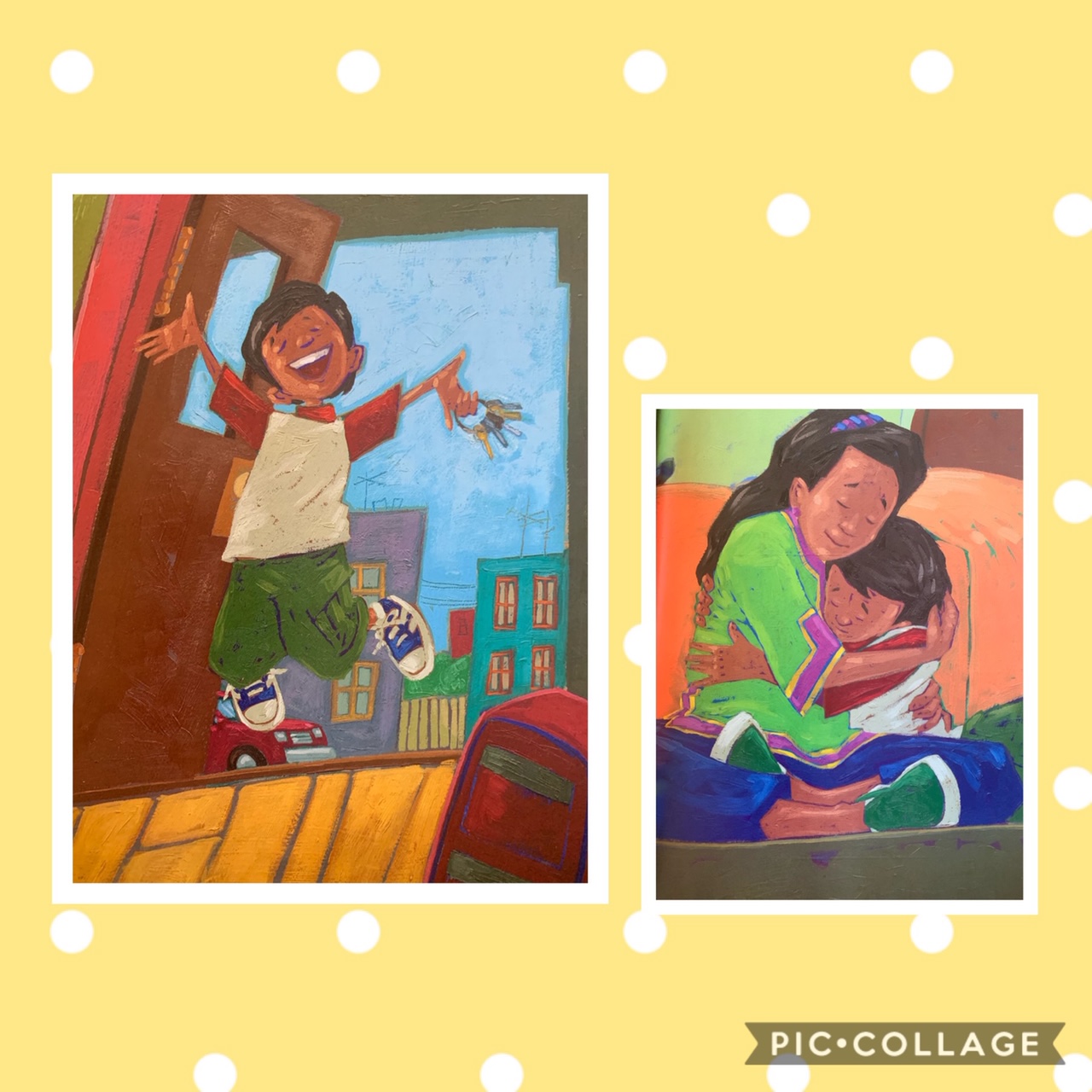
The illustrations provide many elements of visual literacy. The artwork establishes the setting, develops the characters, and reinforces the text. The bright colors in the clothing and buildings capture the essence of Mexico and establish an upbeat mood. The illustration of crossing the border brings understanding to the reader who has never seen a border crossing. The expressions on Jose’s face depicts joy at knowing he will see his mother soon, and sadness at saying good bye.
From North to South is also considered contemporary realistic fiction. Though this is fiction, this type of story could happen and does happen everyday. Many children may have heard about immigration or even know someone who has migrated to the United States. This issue continues to be relevant. The main character is a child that is easy to connect to, and he has recognizable emotions that children can identify with. Tunnel et al. stated about contemporary realistic fiction, “young readers can find their own lives, recognize friends, and meet strangers who can show them different ways of living and thinking” (2016, p. 145).
References
Tunnell, M. O., Jacobs, J. S., Young, T. A., & Bryan, G. (2016). Children’s literature, briefly (6th ed.). Upper Saddle River, NJ: Pearson.
Awards: Stonewall Book Award, Walter Dean Myers Award
Book Focus: Realistic Fiction
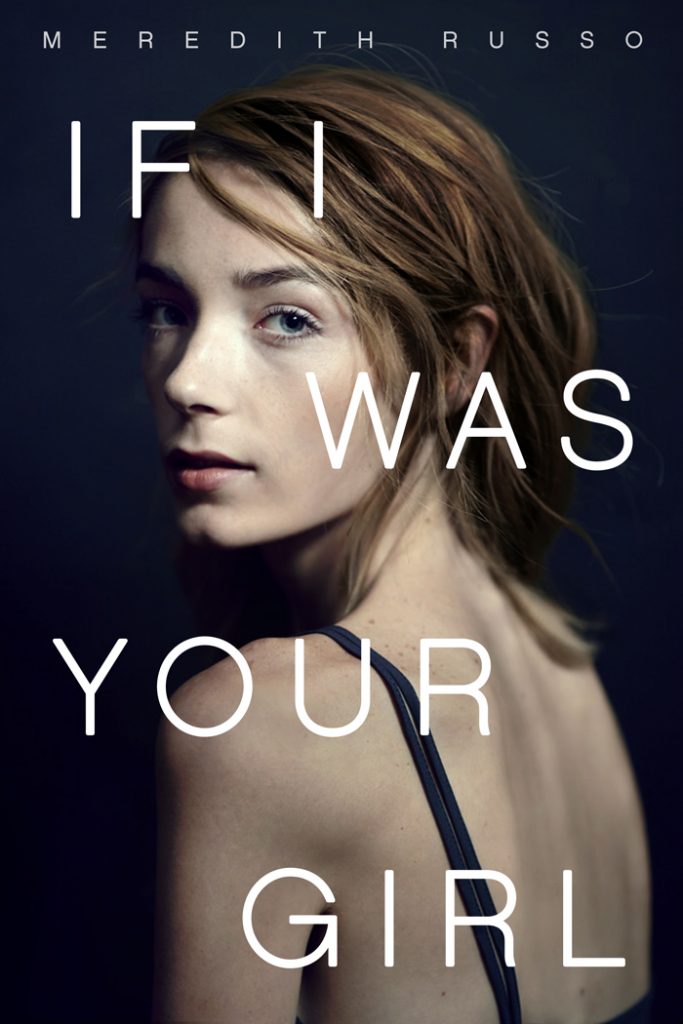
Meredith Russo is from Chattanooga, TN and If I Was Your Girl is her first novel. She, like her character Amanda, is a transgender woman and wanted to write a realistic, yet hopeful, story similar to her own experiences. Meredith Russo’s next book will be released in 2019.
If I Was Your Girl is the story of Amanda, a teen girl who has recently moved to a new town to live with her father, after transitioning from male to female. She tentatively starts attending a new high school and making friends, after having dealt with bullying and depression in the past. Amanda is torn between revealing her past in attempt to be open and truthful and concealing her history in order to protect herself. She learns the power of family and friendship and the journey of self-acceptance.
Tunnel, et al. stated that, “Contemporary realistic fiction tells a story that never happened but could have happened” (2015, p. 138). The character of Amanda, a transgender teenager, has a story that many teens could relate to, though there haven’t been many books written from this perspective to date. Teens and young adults who have not experienced the reality of transgender people can connect with many themes in the book, such as friendship, family, and self-acceptance, while also learning about life from another viewpoint. Tennel et al. also stated, “In this genre are the experiences in my world that I do not yet have- books dealing with specific regions, cultures, nationalities, minorities, and subgroups that provide an expanded understanding of my world'” (2015, p. 139). If I Was Your Girl fits into the Problem Novel category of Contemporary Realistic Fiction. (Tunnel et al. 2016). The novel centers around Amanda’s problems both in the past and the present. She has always felt different, felt that she should be a girl. After much bullying and a suicide attempt she tells a doctor,
“It feels wrong to be a boy, though. When my hair gets long and people mistake me for a girl, I feel happy. I try to imagine what kind of man I’ll grow up to be, and nothing comes. I think about being a husband or a father and even if it’s with a man I feel like I’m being sucked into a black hole. The only time I feel like I have a future at all is if I imagine I’m a girl in it.”
If I Was Your Girl, p. 30
The chapters that take place in the past show the reader how Amanda, then called Andrew, struggled to fit in, both at school and with her dad, who desired a “typical” father son relationship. The problems that she faced then and the problems that she faces in the present time of the book are the focus of the plot. In the present day Amanda is primarily struggling with the question of if she should tell her new friends and her new boyfriend that she is transgender.
” I thought of going the rest of my life pretending I sprang to life from nothing at sixteen years old and felt my cheeks flush with shame and anger. I was so tired of cowering. I was so tired of hiding. I wanted to tell the truth, to say it out loud.”
If I Was Your Girl, p. 46
She is also navigating the relationship with her father, whom she hasn’t spent much time with since her suicide attempt and transition. In the end, after a traumatic scene at the Homecoming Dance, and after respite at her mom’s house, Amanda comes to a place of peace and acceptance.
“Either way, I realized, I wasn’t sorry I existed anymore. I deserved to live. I deserved to find love. I knew now- I believed, now- that I deserved to be loved.”
If I Was Your Girl, p. 273
If I Was Your Girl has many opportunities for discussions focused on critical literacy. The story of a transgender teen is not common place at this time, and is disrupting the norm, and there is much to consider. Why has this voice been silenced for so long, and in may ways is still silenced? Can students imagine feeling like Amanda- feeling uncomfortable in your skin, afraid to be your true self, and to feel lost in your life? This book can encourage students to stand up for others when they witness bullying and to be accepting and open-minded of others and their journeys. There are also many social issues that surround the rights of transgender people that could inspire action in students. If I WasYour Girl is a story of a brave and strong young adult navigating difficult circumstances with maturity and dignity.
References
Tunnell, M. O., Jacobs, J. S., Young, T. A., & Bryan, G. (2016). Children’s literature, briefly (6th ed.). Upper Saddle River, NJ: Pearson.
Russo, M. (2016). If I was your girl. New York, NY: Flatiron Books.
Awards: Newbery Medal, Caldecott Honor, Coretta Scott King Illustrator Honor Book, New York Times Book Review Notable Children’s Book, etc.
Book Focus: Realistic Fiction, Picture Book
When Matt La Peña was a child he struggled in school and with reading. Basketball was his main interest and he went to the University of the Pacific on a full athletic scholarship. While there he fell in love with literature, which changed his life. He is now an award winning author and has written young adult books and children’s books. Many of his books deal with the themes of race and sports. In addition to his writing, he also teaches creative writing and speaks at schools.
Christian Robinson began his career as an animator after graduating from animation school. A children’s book agent noticed his art on his blog and asked Christian if was interested in making children’s books. Christian has now illustrated several children’s books and recently released his first book as author and illustrator. He is known for his bold and classic style.
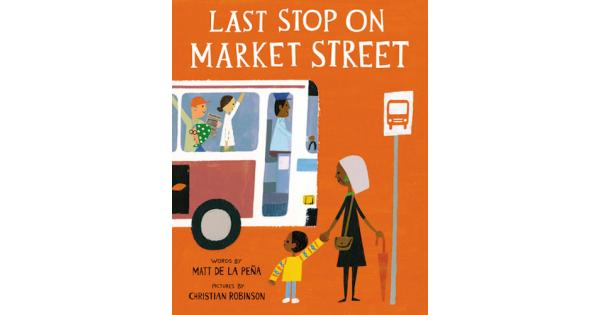
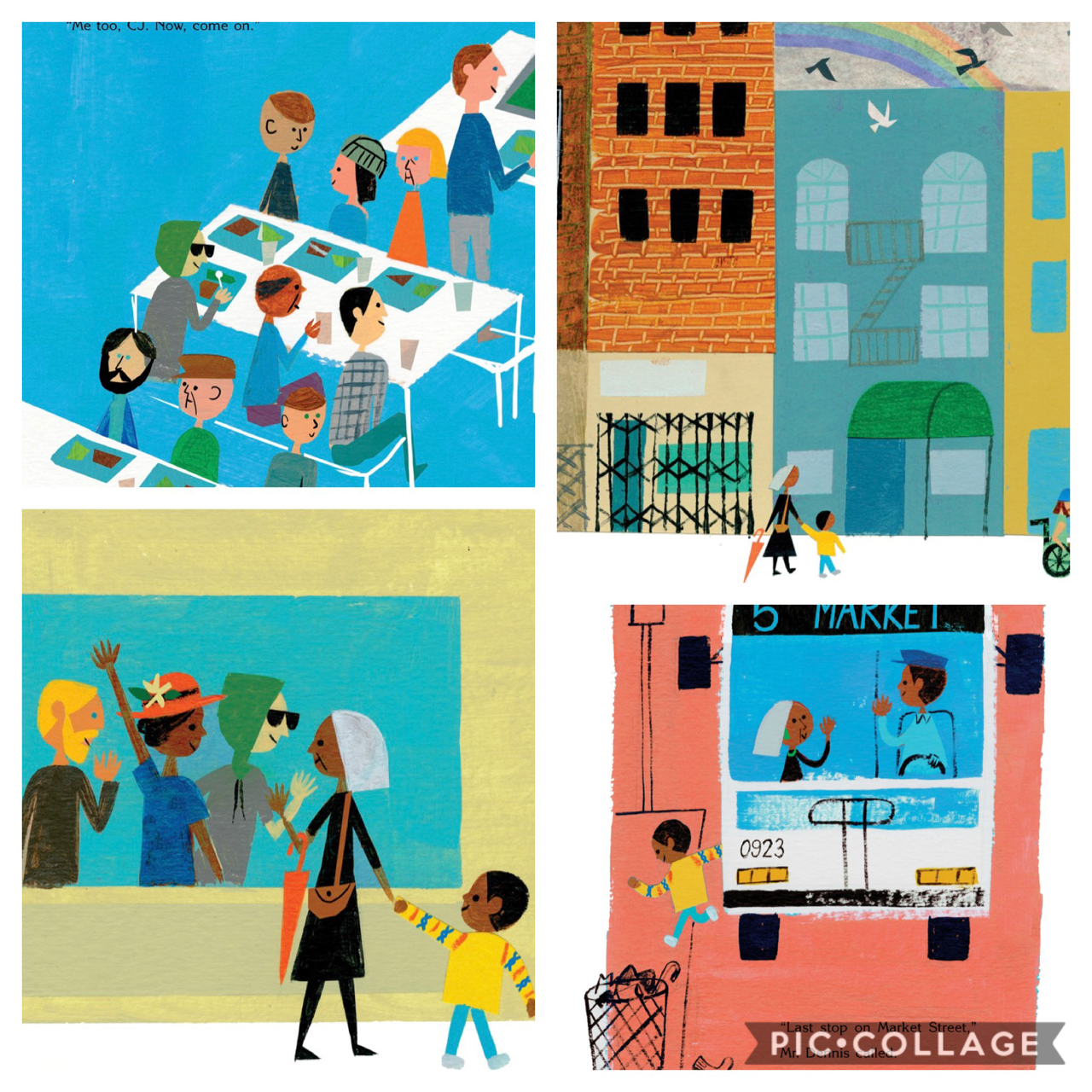
Last Stop on Market Street is a simple, yet profound story about a young boy named CJ and his grandmother. They board the bus for Market Street after church on a Sunday. CJ questions why they take this trip every Sunday and seems to wish he could go play. His grandmother, however, helps him to notice the beauty and value in the people on the bus with them and the neighborhood and places around them. They depart the bus in a rundown area and as CJ sees the people in the soup kitchen, he is glad they came to volunteer.
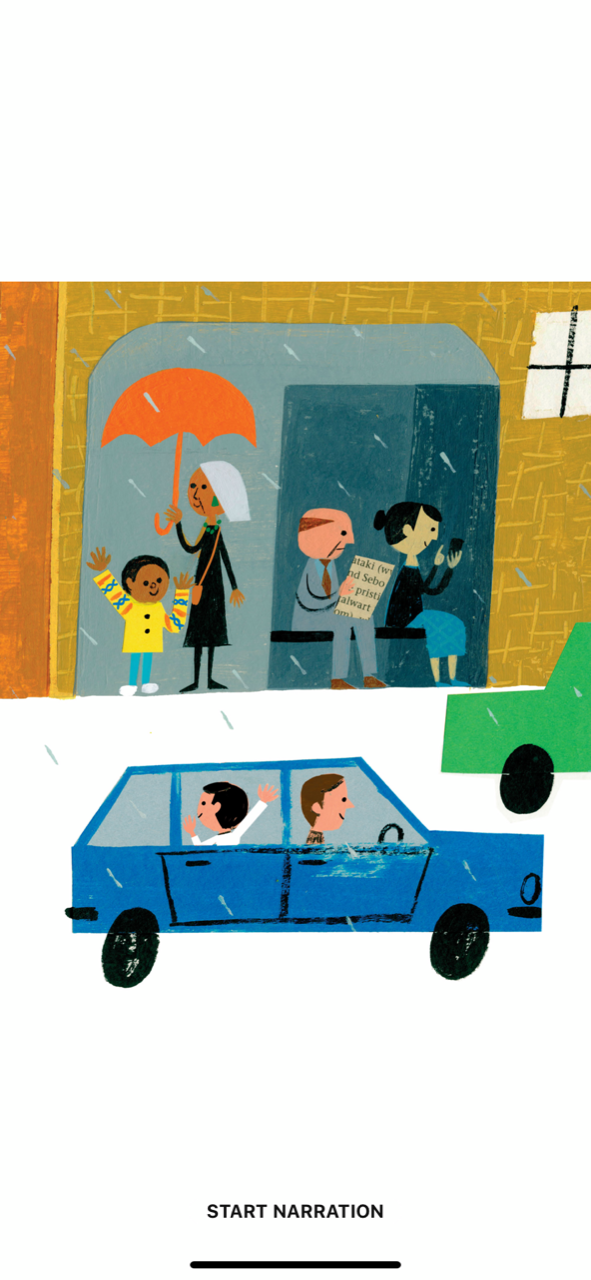
Last Stop on Market Street is a beautiful book, in both the language element and the visual element. The sweet and simple illustrations match the tender story. Christian Robinson used paint and collage elements to create the striking artwork. I love the mixture of paint and collage, especially on page six, which shows people waiting at the bus stop, complete with a man reading a newspaper with realistic looking print. Illustrations in this book play a large part in creating the setting of the book. We, as readers, feel as if we could step right into this neighborhood. The details also bring the characters to life. We notice the tattoos on a man on the bus and the earbuds of the teens listening to music. Though the illustrations are simple and almost child like, there is a lot of detail that brings realism to the setting. For example, throughout the book we see graffiti on buildings, chain link fences with barbed wire, pigeons, overflowing trash cans, and crosswalks. Robinson uses a lot of simple shapes in the illustrations. The cars, for instance, are boxy and rectangular shaped. There are many other visual uses of box-like squares and rectangles. The buildings, the bus windows, the bus itself, the tables in the soup kitchen, and the shopping cart are all ways that the shape is used to create a pleasing and bold composition.
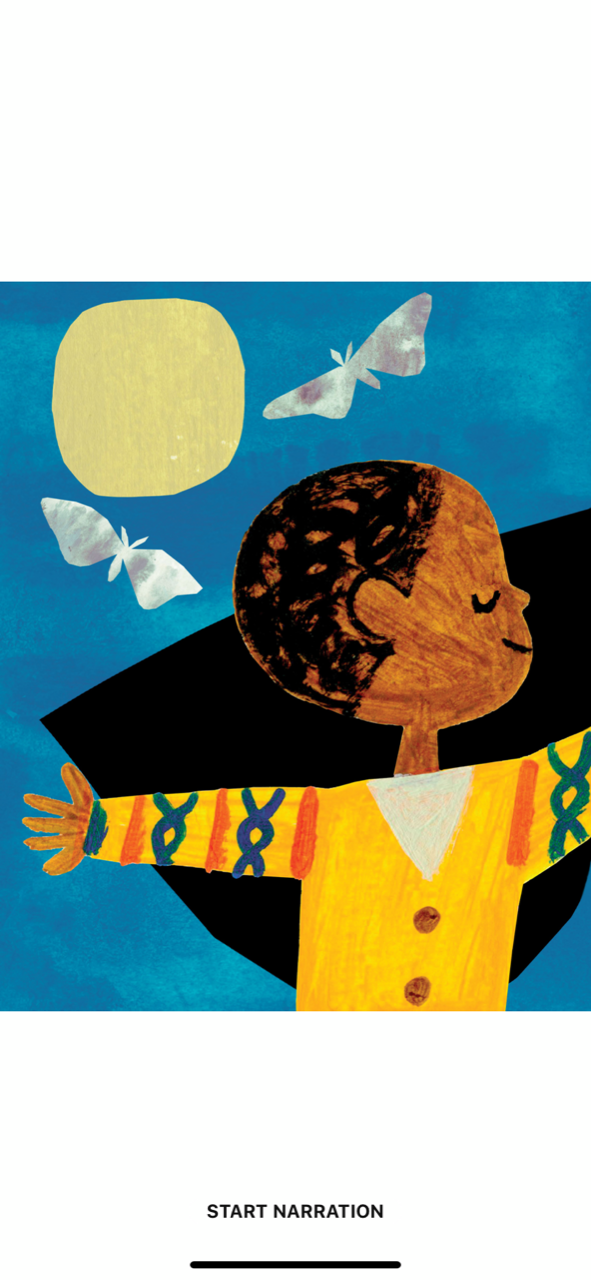
Another visual aspect of note is the setting of the mood. On page seventeen we see CJ’s reaction to the man playing the guitar. Matt de la Peña (2015) writes, “And in the darkness, the rhythm lifted CJ out of the bus, out of the busy city” (p. 17). We see CJ with eyes closed, not on the bus, but under a night sky under the moon and with birds flying by. In this picture we can feel with CJ how the music is affecting him. The mood in this scene is peaceful and serene. The mood through the rest of the book is both realistic and gritty and at the same time, cheerful. We see the rundown aspects of the setting, but the cheerful colors and bold composition keep the mood light. The mood plays an important role in the theme of finding beauty in the mundane or the bleak.
Last Stop on Market Street is an example of contemporary realistic fiction. Tunnel et al. stated that, “Contemporary realistic fiction tells a story that never happened but could have happened” (2016, p. 137). The simple plot, story line, a child as the main character, and the realism in the illustrations make this story feel like it could have happened. This story is about one common event that many people can relate to. Children could experience this book and connect with the story, or have had a similar experience on a bus, at a soup kitchen, or going somewhere with a grandparent. Last Stop on Market Street could be classified in the School and Family category of Realistic Fiction (Tunnel, et al. 2016). There isn’t necessarily a problem to be solved, but more of an experience with family and a lesson learned. This books is also an example of wonderful writing. Tunnel et al. stated that, “The difference between providing sensory detail and generalizing is the difference between showing and telling” (2016, p. 25) For example, de la Peña wrote,”it also smelled like the rain, which freckled CJ’s shirt and dripped down his nose” (2015, p. 2). This book is also an example of revealing truth and insights (Tunnel, et al, 2016). Nana said to CJ, “Sometimes when you’re surrounded by dirt, CJ, you’re a better witness for what’s beautiful” (de la Peña, 2015, p. 22). Though a simple story with simple illustrations, Last Stop on Market Street is a touching, insightful book.
References
Tunnell, M. O., Jacobs, J. S., Young, T. A., & Bryan, G. (2016). Children’s literature, briefly (6th ed.). Upper Saddle River, NJ: Pearson.
de la Peña, M. (2015). Last stop on market street. New York, NY: G.P. Putnam’s Sons.
Awards: Newbery Award, Mythopoeic Fantasy Award, Caldecott Award
Book Focus: Fantasy
photo credit Alan Bradley
Grace Lin was born in upstate New York as the only Asian family in her town. She drew a lot as a child and eventually graduated from the Rhode Island School of Design. Grace has written more than a dozen books and won many awards. Some of her books include Ling and Ting,When the Sea Turned to Silver, and A Big Mooncake for Little Star. She has also become a proponent for diversity through public speaking and her role as a reviewer for the New York Times.
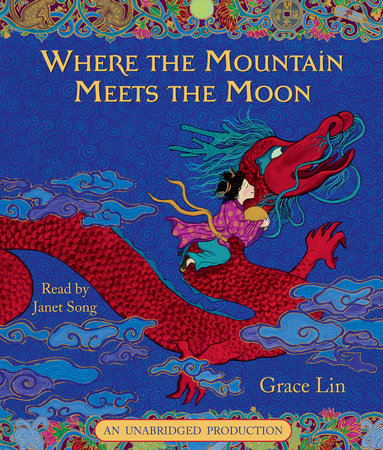
Where the Mountain Meets the Moon is the story of a girl named Minli who sets off on journey to find the Old Man of the Moon who lives on the Never-ending Mountain. She lives with her parents in a small village, where they struggle to survive, but her father entertains them with folklore stories. She is hoping to find a fortune to bring back to her parents, who work very hard and are still very poor. On her journey she meets many friends and hears their stories. While she is gone, her parents are worried and sad, yet they come to realize what is most important to them. Though separated, both Minli and her parents learn lessons of contentment and gratitude. The people that Minli meets and the stories she hears on her journey have a great impact on her family and her village.
Where the Mountain Meets the Moon is a modern fantasy novel. Tunnel, et al. stated, “As with traditional fantasy, modern fantasy is distinguished from other genres by story elements that violate the natural, physical laws of our known world- events akin to magic” (2015, p. 123). This book contains many of these elements, such as a talking goldfish, a talking dragon, the magical peach tree, the red thread becoming a bridge, and the transformation of Fruitless Mountain, among other events. Where the Mountain Meets the Moon also contains many components of the six basic fantasy motifs (Tunnel et al. 2015). There are instances of magic, as previously noted. There also aspects of heroism in the character of Minli. After she foolishly spends what little money she has on a goldfish that they cannot afford to feed, she decides to let it go in the river. While doing this the goldfish suddenly speaks to her:
“Ma will never stop sighing until our fortune changes. But how will it ever change?” Minli asked ruefully. “I guess that is another question for the Old Man in the Moon. Too bad no one knows how to get to Never-Ending Mountain to ask him anything.” The fish stopped swimming and looked up at Minli. “I know where it is,” it said.
Where the Mountain Meets the Moon, p. 27-28
This interaction with the goldfish sets Minli off on her journey. She “must survive various trials in the new environment” (Tunnel, et al, 2015, p. 128). On her way to find the Never-Ending Mountain she encounters monkeys guarding peach trees and the Great Green Tiger that attacks her new friend, Dragon. The Green Tiger and the Magistrate are the symbolic representation of evil in the book. Minli is protected by the dragon throughout their journey, although she also saves his life after he is attacked by the Green Tiger. Other parts of the heroism motif include becoming mature and returning home. Minli decides that she is thankful for what she has and does not need a fortune. After asking for the dragon to be able to fly, she returns home to her parents and her village. This book also contains fantastical objects, another modern fantasy motif, such as the red thread and the Book of Fortune.
Critical literacy skills could be incorporated into the study of Where the Mountain Meets the Moon in several ways. It would be intriguing to ask students if they would sacrifice their one question to ask the Old Man in the Moon and ask Dragon’s question instead. Minli had traveled so far and been separated from her parents, but when she could finally ask for her fortune, she realized she didn’t need it. She instead chose to ask for Dragon’s wish.
“For the line was only made of one word, written over and over again. And that word was Thankfulness. And suddenly, like the light when the clouds move away from the moon, Minli knew clearly what question to ask. ‘There is a dragon waiting at the bridge,’ she said. ‘Why can he not fly?'”
Where the Mountain Meets the Moon, p. 250
Children might have varying perspectives about their responses if they were in Minli’s situation. This book also shows both Minli’s viewpoint and some of her parents’ viewpoint. Students could share in greater depth how the parents might be feeling to explore that perspective further. The question of the author’s purpose in writing this book is also interesting. Grace Lin seems to have written a folktale embedded with folktales. There is a theme of contentment and gratitude that may have been part of her intent as well. Discussion about the roles of the Magistrate and his subordinates could relate to power issues in society. Social justice issues could be explored in the story of the magistrate and the way he treated his subjects. This could be compared and contrasted to other world leaders either present day or from history. Where theMountain Meets the Moon is full of magical, insightful, and relevant meaning.
References
Tunnell, M. O., Jacobs, J. S., Young, T. A., & Bryan, G. (2016). Children’s literature, briefly (6th ed.). Upper Saddle River, NJ: Pearson.
Lin, G. (2009). Where the mountain meets the moon. New York, NY: Little Brown Co.
Author/Illustrator: Cece Bell, color by David Lasky
Awards: John Newberry Award, Eisner Award
Book focus: Partial biography, graphic novel
Cece Bell is an author and illustrator of several books, including the Sock Monkey series, Rabbit and Robot, and El Deafo. She was born in Richmond, Virginia and has degrees from the College of William and Mary and Kent State. She wrote the award winning El Deafo to chronicle her experience of hearing loss at age four and her experience of growing up deaf. She is married to well known author Tom Angleberger. She hopes to be known as, “that AWESOME author and illustrator that happens to be deaf!”
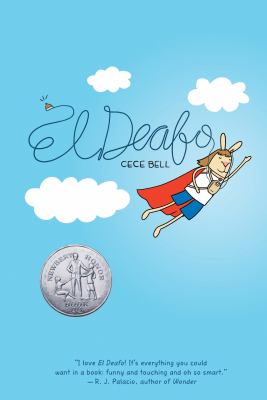
El Deafo is a partial autobiographical account of Cece Bell’s life from the age of four until the age of eleven. When she was four years old, Cece Bell lost her hearing after being ill with meningitis. The book details her diagnosis and process of getting hearing aids and the Phonic Ear, which she used at school, attached to a microphone that the teacher wore. The story follows Cece as she moves through elementary school and struggles to make friends, accept her differences, and advocate for the ways she does and does not want to be treated as a deaf person.
Cece Bell was already a published author and illustrator when she wrote her autobiographical book, El Deafo. This work falls under two categories of biographical text, both the category of people from the arts and autobiographies (Tunnel, et. al, 2016). She began writing a blog that included stories and feelings about being deaf after a frustrating interaction with a cashier in a store. She had not been very open about being deaf before this point in her life. The blog eventually led to her writing this book. She wrote El Deafo in order to share her personal story (she points out that not all deaf people have the same feelings, attitudes, or experiences) and as a way to inform hearing people how to respectfully treat and interact with people with hearing loss. The last few pages of the book include a note from the author describing many aspects of the deaf community and how she has chosen to integrate into that community.
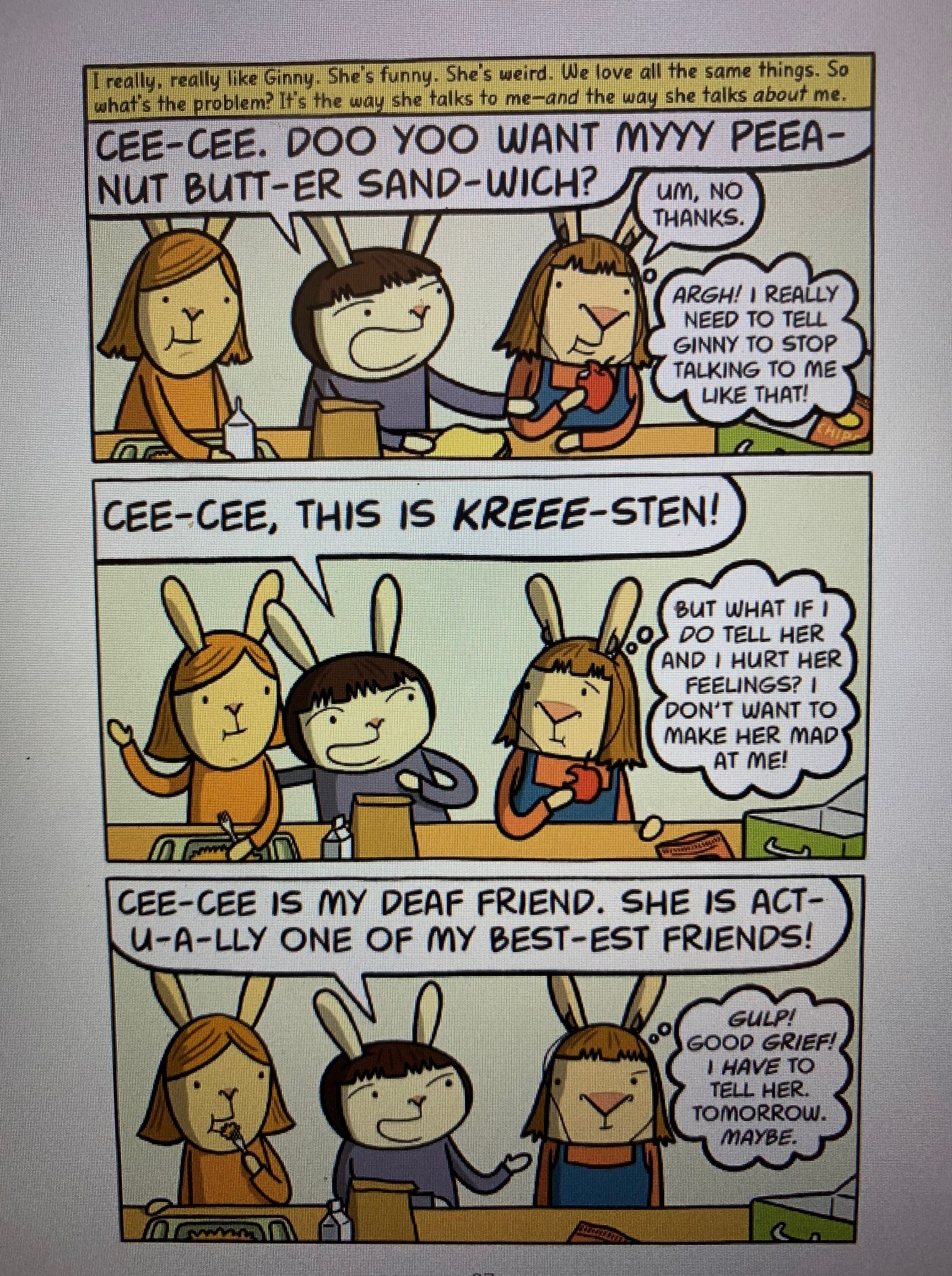
There are many qualities in El Deafo that make it a well written book. As a graphic novel, the text is primarily comprised of dialogue and Cece’s thoughts. The writing of the dialogue helps us get to know the characters and moves the plot forward. It was stated in Children’s Literature, Briefly, “Speech reveals character. When a person’s mouth opens, truth emerges about personality, motives, desires, prejudices, and feelings” (Tunnel, et al. 2016, p. 27). This is especially true in El Deafo, in which the way other people talk to Cece reveals their thoughts and prejudices about Cece and her hearing loss. For example, her friend Ginny speaks very loudly and slowly to Cece because she assumes that will be helpful. This is, in fact, frustrating to Cece, and not the type of help she needs. Ginny’s dialogue is written in all capital letters with some letters repeated and dashes in the syllable breaks to show the slowness. The dialogue serves to demonstrate not only what the characters say, but what they think and feel, as well.
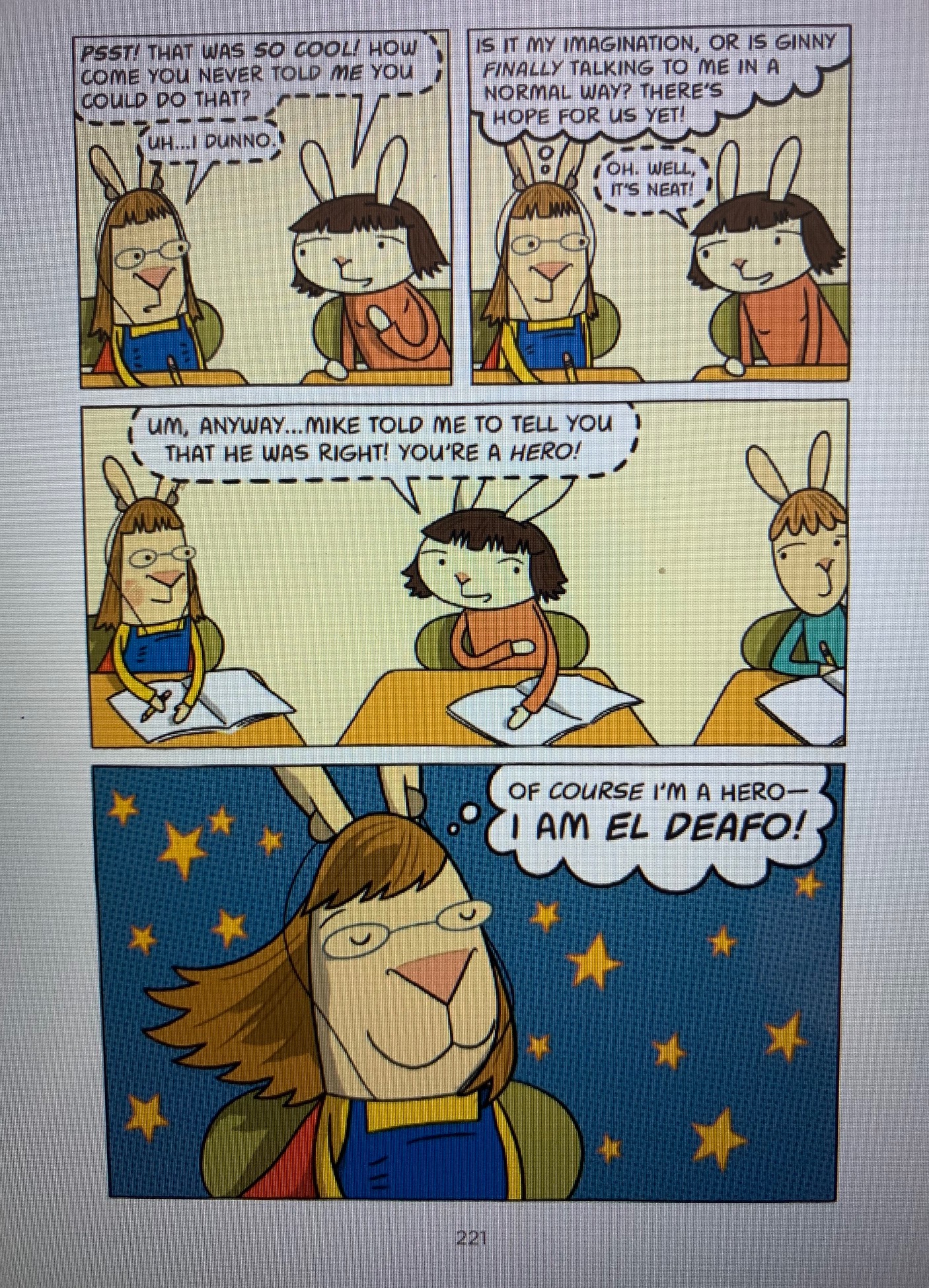
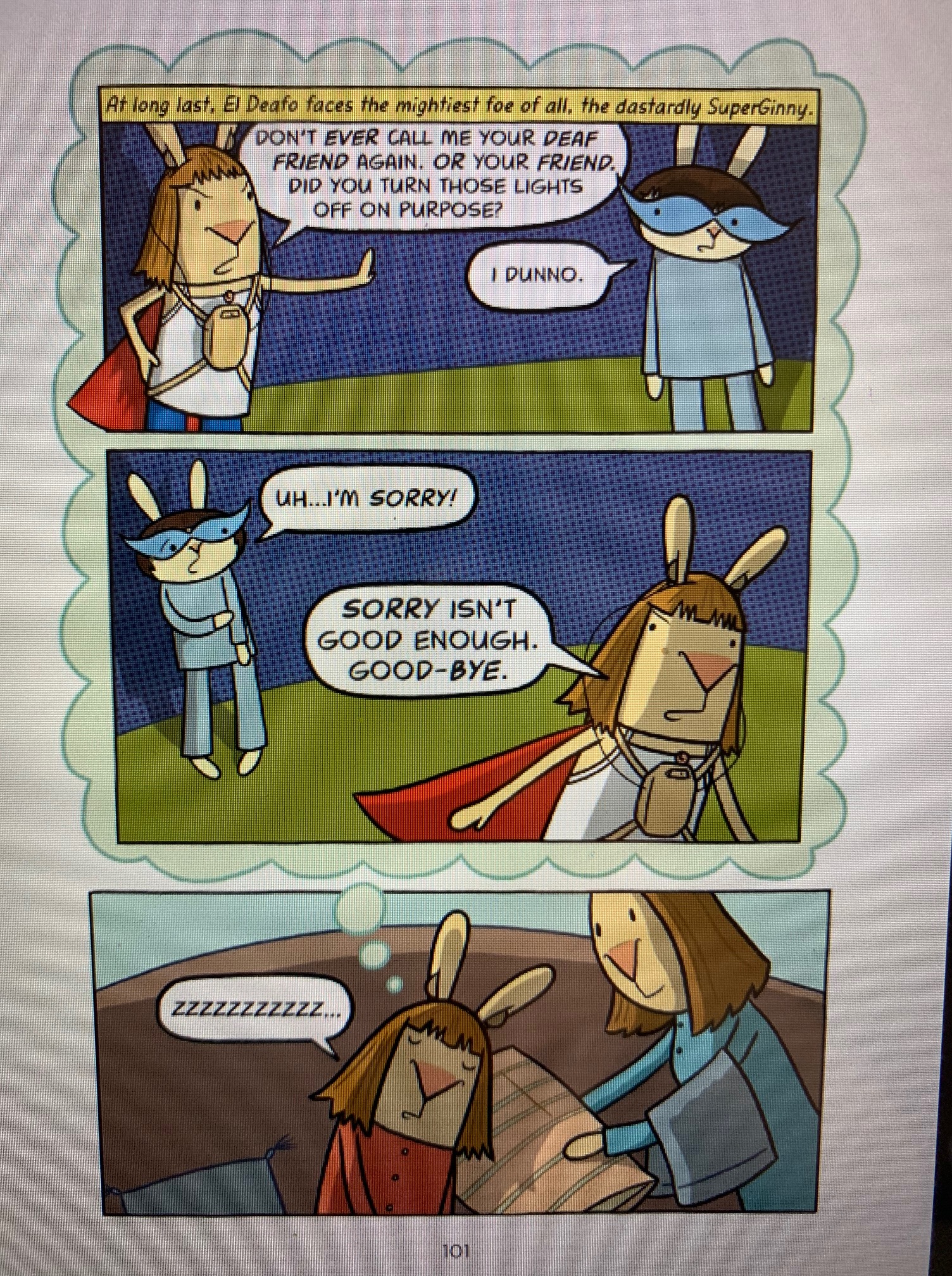
The creation of the El Deafo character serves to show us another side to Cece, the part of her that wants to be brave and say what she really thinks. El Deafo is the superhero counterpart to her character. Bell uses this as a way to reveal her character’s thoughts and desires and also to educate the reader about communication with someone who is deaf. Throughout the book we see Cece struggle to tell people how she feels and with her own acceptance of her hearing loss. She feels self conscious and different than everyone else. By the end of the book Cece has become more confident and has found acceptance in her school, her friend group, and her neighborhood. As stated in Children’s Literature, Briefly, “autobiography provides the unique viewpoint of self-revelation” (Tennel, et al. 2016, p. 171). We see Cece develop her own thoughts about friendship and deafness. The reader will interact with these themes from their own perspectives of friendship and other-ness.
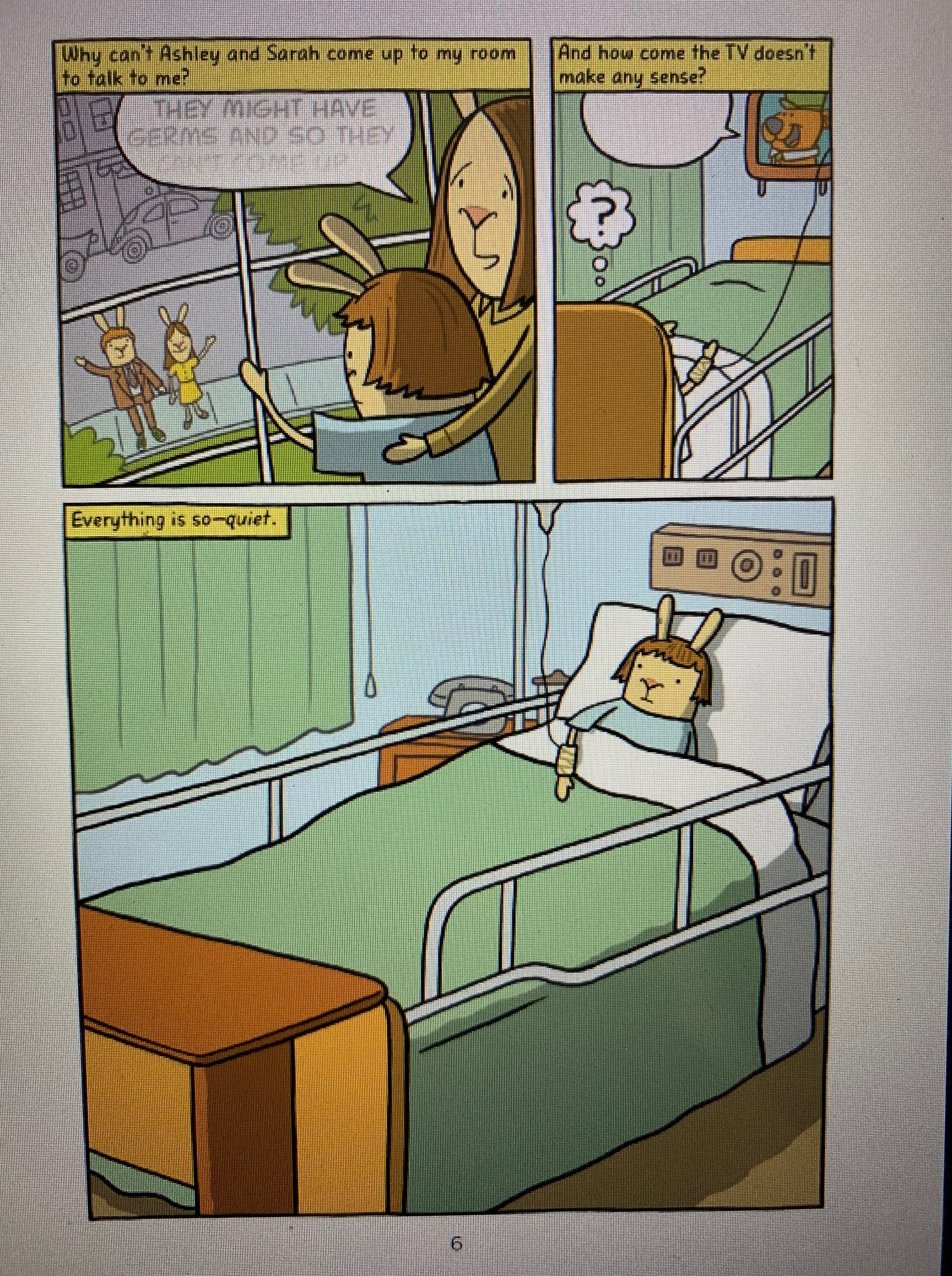
The artwork in El Deafo supports the text in several ways and impacts readers in many ways. Bell states that, “Rabbits were the perfect visual metaphor for my experience. Rabbits have big ears and amazing hearing. As the only kid in my school who was deaf, I felt like the one rabbit whose big ears didn’t work.” Visually, the rabbit makes the characters appealing to children and also represents the ostracized feelings of Cece. The use of font also plays a role in the story by revealing plot changes. For example, on page 6, Cece is in the hospital with meningitis. She is losing her hearing and the printed type in the text bubbles gets lighter as she hears less, and the subsequent text box is empty. The use of different font type for different situations increases children’s visual literacy. Students may notice that print in a bubble with a yellow background and red border is showing what Cece hears from the Phonic Ear. When someone is speaking loudly the font is large. If Cece is imagining what her counterpart, El Deafo, might do, there is a dotted background to the panel. These are patterns that children can notice that will enhance their comprehension of the story. The detail in the realistic drawings adds to the story, making it believable. Each of the characters looks different in appearance and their facial expressions add depth to the character development and plot.
Students may sympathize with Cece and feel a connection to her, or they may feel more connection to the friends and classmates, depending on their experiences. This text will elicit a variety of reactions, personal connections, and themes from students.
References
Bell, C. (2014). El deafo. New York, NY: Amulet Books.
Tunnell, M. O., Jacobs, J. S., Young, T. A., & Bryan, G. (2016). Children’s literature, briefly (6th ed.). Upper Saddle River, NJ: Pearson.
Awards: National Book Award finalist, IRA Teacher’s Choice, Scott O’Dell Award for Historical Fiction, Notable Children’s Book Award by Association of Library Service to Children
Book Focus: Historical Fiction
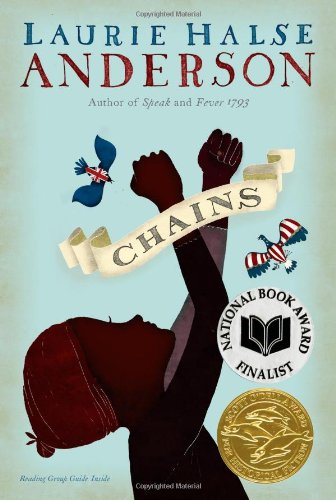
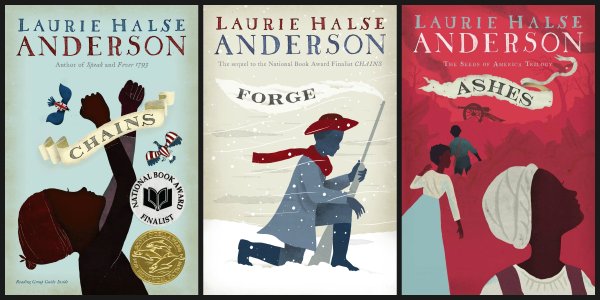
Chains was written by Laurie Halse Anderson in 2008. It tells the story of a fictional character, Isabel, during the real events of the Revolutionary War in New York. Isabel is a slave in Rhode Island who had been promised freedom, who along with her younger sister, are sold to a man and his wife in New York after their previous owner died. They arrive in New York in May 1776, just as the war is reaching its heights and tensions are high among Patriots and Tories. Isabel suffers in the house of her owners and is separated from her her sister. She escapes with her friend Curzon at the end of the book. Their story will continue in the next two books in the series.
Chains is an example of historical fiction that takes place exclusively in the past and before the author and audience was living (Tunnel et al, 2016). According to Children’s Literature, Briefly, “Historical fiction is judged by the same criteria as any other piece of fiction: strength of character development, credibility of plot, quality of writing style, definition of setting, handling of theme” (Tunnel et al, 2016, p. 155-156). The skillful character development in this text creates a strong connection between the character of Isabel and the reader. As I read this book I was brought to tears by the scene of Isabel being branded. Anderson writes,
“The man pushed the hot metal against my cheek. It hissed and bubbled. Smoke curled under my nose. They cooked me. The man stepped back and pulled the iron away. The fire in my face burned on and on, deep through my flesh, searing my soul. Stars exploded out the top of my head and all of my words and all of my rememberies followed them up to the sun, burning to ash that floated back and settled in the mud.”
Chains, p. 185
The branding of Isabel holds significant symbolism in the book and also presents one of the indicators of quality historical fiction, which is that history should not be watered down (Tunnel et al, 2016). Children are not shielded from realistic examples of the treatment of slaves during this time period. Madam, the wife of the home, treats Isabel and her sister poorly and renames Isabel as Sal. The branding is punishment for her anger in hearing that her sister has been sold. Isabel yells at Madam, calling her a rude name and running away after Madam strikes her with a painting. The branding is meant to make Isabel feel shame and to be an example to other slaves, but Isabel is able to find strength in her scar. The letter I that has been branded into her cheek is meant to stand for insolence, but to her it stands for Isabel, her true name and her true self. She also connects the brand to her father, who had three scars on his face. The scar is symbolic of overcoming adversity, finding strength within yourself, and family connections. She says near the end of the book,
“I turned my head to the side a bit and studied the brand on my face; for the first time, studied it hard: the capital “I” that proclaimed my insolent manners and crimes. I leaned over closer to the mirror. The letter was a pink ribbon embroidered on my skin. I touched it, smooth and warm, flesh made into silk. The scars on Poppa’s cheek had been three lines across his cheek, carved with a sharp blade. He was proud of his marks. In the country of his ancestors, they made him into a man. I traced the “I” with my fingertips. This is my country mark. I did not ask for it, but I would carry it as Poppa carried his. It made me his daughter. It made me strong. I took a step back, seeing near my whole self in the mirror. I pushed back my shoulders and raised my chin, my back straight as an arrow. This mark stands for Isabel.”
Chains, p. 355
We become connected to Isabel in this book, and we see the historical events through her eyes, another marker of quality historical fiction (Tunnel et al, 2016).
Another trademark of quality historical fiction is presenting multiple perspectives (Tunnel et al, 2016). Chains provides insight into both the Loyalists’ and the Patriots’ feelings and views on the colonists’ independence. We see these viewpoints through the characters that Isabel interacts with, and we see how her own thoughts change back and forth throughout the book as she tries to decide which side is more likely to help her. This aspect lends itself well to transactional theory, whereby the reader will bring their own schema and cultural ideas to the text and may create their own meaning of the text. Readers, depending on their own experiences, may have various thoughts about the colonies’ rebellion from the king. The readers may also have a variety of reactions to Isabel. Teachers may ask their students to consider questions like, Should Isabel have done something different to assert her freedom before being sold to the Locktons in New York? Should Isabel have tried to run away earlier? Should Isabel have become a spy for the Patriots?Why did Isabel stop speaking for a while after being branded?Should Jenny or Lady Seymour tried harder to keep Isabel and Ruth from living with the Locktons?What do you think you might have done in each of these situations? Students might have more than one idea about the main theme of the book, and should be encouraged to share their ideas.
I would rate Chains as a high quality historical fiction novel. There are valuable themes of justice, equality, and personal strength, The setting and events of the time period are accurately portrayed and help the reader understand the events of history and feel as if they are there alongside the characters. The attempted assassination of George Washington, the pamphlet Common Sense, and the fire in New York City are accurately portrayed, but through Isabel’s eyes. The characters are believable and relatable, and the complexity of the issues of the historical events are explored in depth. The language is beautiful, almost poetic. I love Isabel’s use of the word “rememberies” for memories, because it is endearing and sweet. Several times I re-read a sentence or paragraph to appreciate the imagery and figurative language. One example is on page 184, when Isabel thinks, “I fought against the tears and lost; they fell tot he dust in big drops, too. If I cried a river, maybe I could swim away, or slip under the water to freedom.” The novel Chains meet all the requirements needed to be named a top historical fiction book.
References
Anderson, L. (2008). Chains. New York: Simon & Schuster.
Tunnell, M. O., Jacobs, J. S., Young, T. A., & Bryan, G. (2016). Children’s literature, briefly (6th ed.). Upper Saddle River, NJ: Pearson.
Awards: Caldecott Honor Book, Coretta Scott King Illustrator Award
Focus of Book: Autobiographical Picture Book
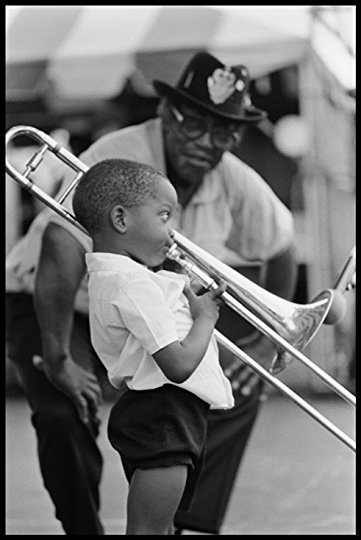
Trombone Shorty is an engaging autobiography of Troy Andrews, a musician born and raised in New Orleans. He began playing the trombone at age four and has had a very successful music career. He and his band, Trombone Shorty & Orleans Avenue, have played with many well known artists all over the world and performed on television shows and at the White House.
Bryan Collier is an award winning illustrator. He was born and raised in Maryland and became interested in art as a young child. He was influenced by the illustrations in books like The Snowy Day and Harold and the Purple Crayon. He won a scholarship to Pratt Institute in New York and graduated with honors. His art has been displayed at the Capitol Building in Washington D.C. It took him many years to have his first book, Uptown, published. When Bryan isn’t making writing and illustrating children’s books, he volunteers at the Harlem Hospital Center and visits schools.
Troy Andrews was born and raised in New Orleans. Music played a very important role in his neighborhood, especially around the time of Mardi Gras. Brass bands would parade through the streets. Troy really wanted to be able to play music, too. One day, when Troy was four years old, he found an old broken trombone and began playing. He earned the nickname “Trombone Shorty” because he was so small compared to the size of the trombone. He and his friends created their own band with homemade and broken instruments. When he went to a Bo Diddley concert with his family, he brings his own trombone and plays along from the crowd. Bo Diddley asks him to play up on the stage with him, and Trombone Shorty’s career is born. He continues playing and practicing and becomes a world renown musician.
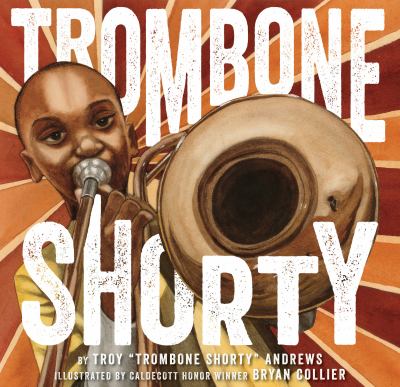
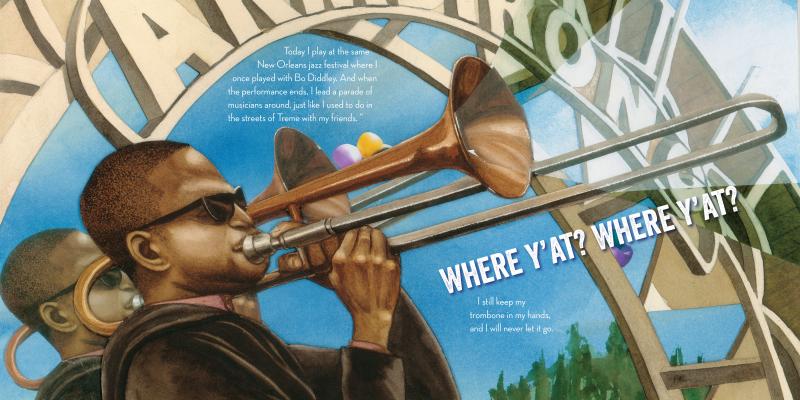
There are several features of the art in this book that promote visual literacy. The paintings are realistic and bold. The use of line and color draws the reader in and captures the reader’s interest. The spiraling lines on pages one and two are examples of leading lines. The layering of the collage elements give the art more texture and depth, which adds meaning to the text. The illustrations in Trombone Shorty transport the reader to New Orleans, to the neighborhood that Troy Andrews grew up in. We are reading about the events of young Troy’s life, but we are also immersed in his culture, his family’s way of living, and the social construct of his neighborhood. We see glimpses of his kitchen, his bedroom, and the streets he lives on. The attention to detail adds to the realism of the text and the art.
The use of font type and size and composition are another aspect of visual literacy. The phrase “Where y’at?” is an important part of the culture and is emphasized with big, bold print, and either black or white colors. On the last page of the book the phrase, “Where y’at?” is placed right under the lines of the trombone slide, creating interesting composition. Collier makes use of composition to draw attention to important aspects of the story. By painting Trombone Shorty and his trombone larger than the other parts of the illustration the reader is drawn to the. As stated in Children’s Literature, Briefly, “Artists can ensure that certain shapes are dominant by making them larger or brighter to attract the eye” (Tunnel et al, 2016, p. 43).
Readers approach the text of Trombone Shorty from their own individual perspectives based on their backgrounds and experiences. The text is inviting the reader into a particular time and place, and the reader is bringing their own cultural experiences to interact with this time and place. Students in a classroom may or may not have experience with jazz music, the trombone, Mardi Gras parades, or the culture of New Orleans. They might, however, make connections to the concepts of desiring to do something, finding a way to accomplish it, and being dedicated to something. Teachers can invite a response from students by asking for initial impressions to the book and then asking some guiding questions about students’ connections to the text and illustrations. Why didn’t Troy’s family just go buy a trombone for him? Why is music important to people? Have you been affected by music? Who else can you think of that has worked toward a goal for their whole life? How did Trombone Shorty’s community help him reach his goal? It might be possible to read Trombone Shorty with an efferent approach, such as reading in order to gather facts about Troy Andrews’ life, but it lends itself more to an aesthetic approach. The illustrations and the written text are almost like music, and the reader is affected by the feelings, memories, and ideas that the book conjures. The interplay between the words and the art create an experience, which might be different for each reader.
References
Andrews, T. (2015). Trombone shorty. New York: Abrams Books for Young Readers.
Tunnell, M. O., Jacobs, J. S., Young, T. A., & Bryan, G. (2016). Children’s literature, briefly (6th ed.). Upper Saddle River, NJ: Pearson.










 Between the Trees