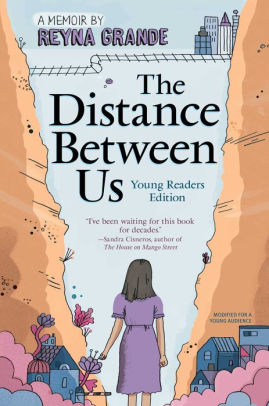
Title: The Distance Between Us, Young Reader’s Edition
Author: Reyna Grande
Awards: Honor Book Award for the Americas Award for Children’s and Young Adult Literature, Eureka! Honor Awards, International Literacy Association Children’s Book Award
Book Focus: Multicultural, Partial Autobiography
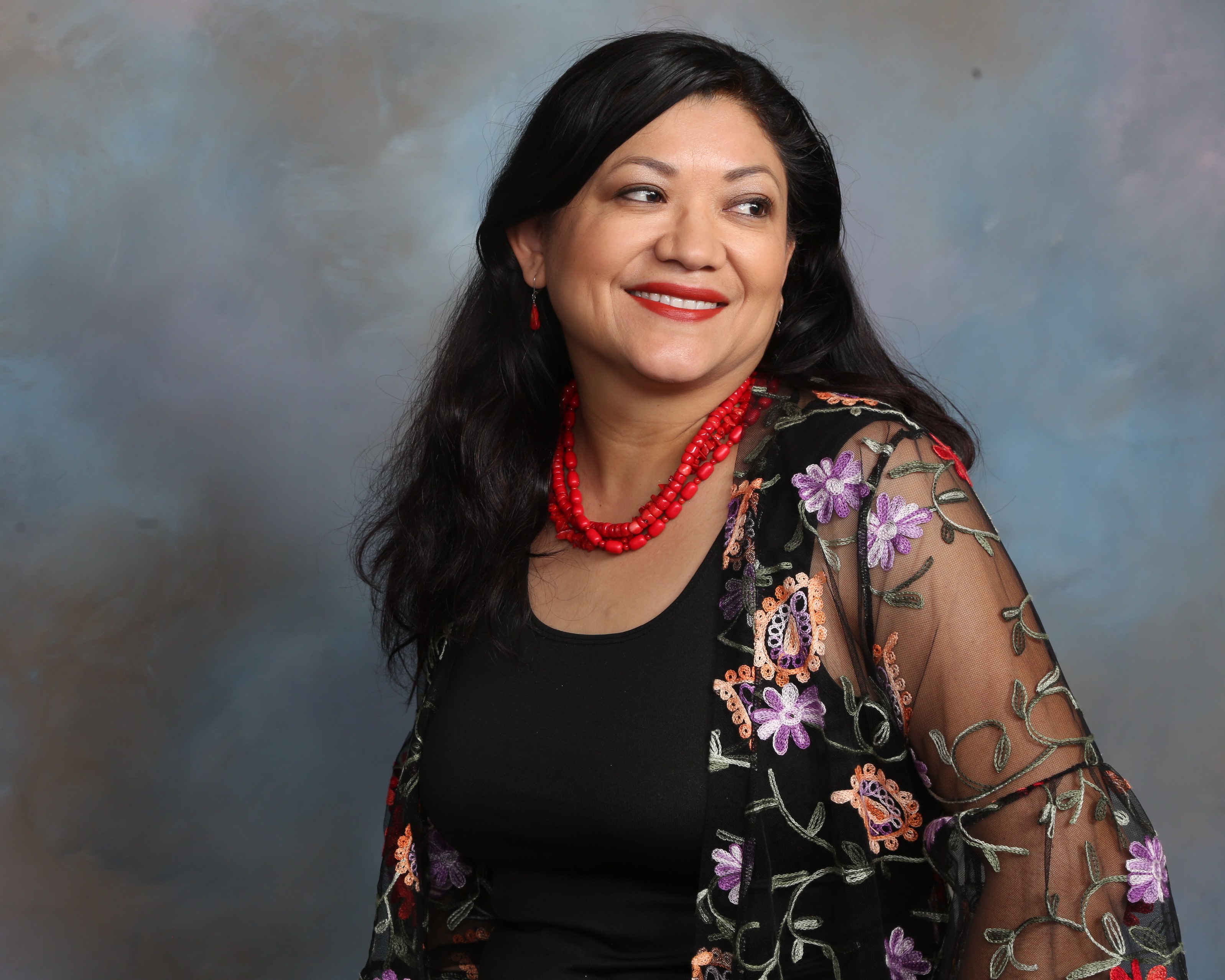
Reyna Grande was born in Iguala, Mexico and lived there until she was nine years old. Her parents left her and her siblings in Mexico with relatives while they sought work and saved money in the United States. Her family was separated for many years until she and her siblings also migrated to the United States. She writes about the struggles of migrant children both before and after migration in her books. Rayna graduated from UCSC with a degree in creative writing and from Antioch University with an M.F.A. in creative writing and is an award winning author and speaker.
The Distance Between Us is a partial autobiographical memoir written by Reyna Grande. She details the early years of her life while she was living in Iguala, Mexico. Her family lived in extreme poverty with little prospects for improvement. Her father left to seek work in the United States when Reyna was two years old, and her mother followed a few years later. Being separated from her parents was traumatic for her and her siblings, and living with relatives was not easy. After her mother returns and leaves again a few times, Reyna and her siblings made the harrowing journey to cross the border into the United States with their father. She writes about adjusting to a new country, her family’s personal struggles, and her path to becoming an author.
The Distance Between Us plays two important roles as part of multicultural literature, depending on the cultural group of the reader. Tunnel et al. stated that multicultural literature can “foster an awareness, understanding, and appreciation of people who seem at first glance different than the reader” and can “present a positive and reassuring representation of a reader’s own cultural group” (2016, p. 200). The Distance Between Us may connect with Latino children who migrated or have family or friends that migrated. Latino readers may also connect with the cultural elements of the book, even if they do not have any personal connections to migration. Grande writes in a relatable, easy style that students will connect to. She describes her traumatic experiences of running across the border, being abused by family members, and being left by her parents in a way that is realistic and invokes empathy. Yet, despite so much adversity, we see Reyna as a strong and determined, and sometimes fearful, girl.
Tunnel et al. stated that, “Cultural details need to be represented accurately in literature” (2016, p. 203). The Distance Between Us contains many details to add to the realism of the book. This book is unique because it is a memoir, so the details are authentic to the author’s experience. There is a scene in which Reyna’s grandfather is cutting off her hair because it is infested with lice.
“I jerked around, crying and yelling for Mami to come. I hated myself for being so weak the night before, when I’d torn the towel off. Tears rolled down my face, and I cried for my hair, because I loved my hair. It was the only beautiful thing I had, curls so thick that women in the street would stop and touch them and tell Mami, ‘What lovely hair your daughter has. She looks like a doll,’ and Mami would smile with pride.”
The Distance Between Us, p. 23.
We can feel Reyna’s distress and understand that her hair was a connection to her mother. The details in the writing make us feel like we are there, making this a culturally specific children’s book (Tunnel et al., 2016, p. 204). Grande writes about Quinceaneras, Mexican myths like La Llorona who roams the canals, and uses Spanish dialect to gain authenticity. Later, after Reyna has been in the United States for several years, she returns to Mexico to visit. At the point she knows that she is not fully accepted as Mexican any longer. She has lost some of her Spanish and she is very different in the way she thinks and acts and dreams now. This feeling of not quite fitting in in either culture, can be understood by many people.
There are many ways that this novel can be used to prompt critical literacy skills. Students can consider what it might be like to be separated from their parents, or to feel that you don’t fit into a group. This story may disrupt the common place for some students who have never thought about parents leaving their children. There are many thought-provoking discussions to be had regarding Reyna’s parents. Should the parents have left Iguala in search of money, or would it have been better for their family if they had stayed? Would it have been better to live in such poverty? Would the parents have stayed together in Mexico? Why did the parents stay away for so long? Why couldn’t they have brought the children with them? Why did Reyna’s mom leave a second time? Why does her mom say they can’t bring Betty with them to the United States? It is interesting to see varying perspectives of the characters. Why does Papi act the way he does? Why does Mila act the way she does? Why do her grandmother and Elida treat Reyna and her siblings the way they do? Also, there are many current events occurring in our country that connects to the immigration issue in a sociopolitical way. There many families being separated at the border and being held in deplorable conditions. The DREAM act which would grant residency status to undocumented minors faces strong opposition. Students may feel compelled to take action to provide relief for immigrants or to make their voices heard through their legislators and senators.
The Distance Between Us contains many writing elements that elevate the telling of the story. I love the description of Abuela Evila’s house as they approach it to stay while their parents are gone. There is a sense of foreshadowing and foreboding. “Abuela Evila’s house sat at the bottom of the hill. It was a small adobe house painted white with a terra-cotta tile roof. Bougainvillea climbed up on one side. The vine, think with red flowers, made the house look as if it were bleeding” (p. 3). The reader is drawn in by this description, and can feel like we are standing in front of Abuela Evila’s house. Grande also makes use of figurative language to show us what is happening and describe the characters. She described Abuela Evila as, “bent to the ground, as if she were carrying an invisible sack of corn” (p. 4). The road on their bus ride is described as “the broken white lines running through it like stitches” (p. 127).
References
Tunnell, M. O., Jacobs, J. S., Young, T. A., & Bryan, G. (2016). Children’s literature, briefly (6th ed.). Upper Saddle River, NJ: Pearson.

 Between the Trees