Title: Where the Mountain Meets the Moon
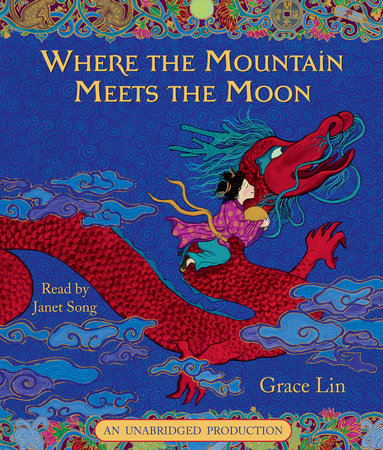
Author/Illustrator: Grace Lin
Awards: Newbery Award, Mythopoeic Fantasy Award, Caldecott Award
Book Focus: Fantasy

Grace Lin was born in upstate New York as the only Asian family in her town. She drew a lot as a child and eventually graduated from the Rhode Island School of Design. Grace has written more than a dozen books and won many awards. Some of her books include Ling and Ting, When the Sea Turned to Silver, and A Big Mooncake for Little Star. She has also become a proponent for diversity through public speaking and her role as a reviewer for the New York Times.
Where the Mountain Meets the Moon is the story of a girl named Minli who sets off on journey to find the Old Man of the Moon who lives on the Never-ending Mountain. She lives with her parents in a small village, where they struggle to survive, but her father entertains them with folklore stories. She is hoping to find a fortune to bring back to her parents, who work very hard and are still very poor. On her journey she meets many friends and hears their stories. While she is gone, her parents are worried and sad, yet they come to realize what is most important to them. Though separated, both Minli and her parents learn lessons of contentment and gratitude. The people that Minli meets and the stories she hears on her journey have a great impact on her family and her village.
Where the Mountain Meets the Moon is a modern fantasy novel. Tunnel, et al. stated, “As with traditional fantasy, modern fantasy is distinguished from other genres by story elements that violate the natural, physical laws of our known world- events akin to magic” (2015, p. 123). This book contains many of these elements, such as a talking goldfish, a talking dragon, the magical peach tree, the red thread becoming a bridge, and the transformation of Fruitless Mountain, among other events. Where the Mountain Meets the Moon also contains many components of the six basic fantasy motifs (Tunnel et al. 2015). There are instances of magic, as previously noted. There also aspects of heroism in the character of Minli. After she foolishly spends what little money she has on a goldfish that they cannot afford to feed, she decides to let it go in the river. While doing this the goldfish suddenly speaks to her:
“Ma will never stop sighing until our fortune changes. But how will it ever change?” Minli asked ruefully. “I guess that is another question for the Old Man in the Moon. Too bad no one knows how to get to Never-Ending Mountain to ask him anything.” The fish stopped swimming and looked up at Minli. “I know where it is,” it said.
Where the Mountain Meets the Moon, p. 27-28
This interaction with the goldfish sets Minli off on her journey. She “must survive various trials in the new environment” (Tunnel, et al, 2015, p. 128). On her way to find the Never-Ending Mountain she encounters monkeys guarding peach trees and the Great Green Tiger that attacks her new friend, Dragon. The Green Tiger and the Magistrate are the symbolic representation of evil in the book. Minli is protected by the dragon throughout their journey, although she also saves his life after he is attacked by the Green Tiger. Other parts of the heroism motif include becoming mature and returning home. Minli decides that she is thankful for what she has and does not need a fortune. After asking for the dragon to be able to fly, she returns home to her parents and her village. This book also contains fantastical objects, another modern fantasy motif, such as the red thread and the Book of Fortune.
Critical literacy skills could be incorporated into the study of Where the Mountain Meets the Moon in several ways. It would be intriguing to ask students if they would sacrifice their one question to ask the Old Man in the Moon and ask Dragon’s question instead. Minli had traveled so far and been separated from her parents, but when she could finally ask for her fortune, she realized she didn’t need it. She instead chose to ask for Dragon’s wish.
“For the line was only made of one word, written over and over again. And that word was Thankfulness. And suddenly, like the light when the clouds move away from the moon, Minli knew clearly what question to ask. ‘There is a dragon waiting at the bridge,’ she said. ‘Why can he not fly?'”
Where the Mountain Meets the Moon, p. 250
Children might have varying perspectives about their responses if they were in Minli’s situation. This book also shows both Minli’s viewpoint and some of her parents’ viewpoint. Students could share in greater depth how the parents might be feeling to explore that perspective further. The question of the author’s purpose in writing this book is also interesting. Grace Lin seems to have written a folktale embedded with folktales. There is a theme of contentment and gratitude that may have been part of her intent as well. Discussion about the roles of the Magistrate and his subordinates could relate to power issues in society. Social justice issues could be explored in the story of the magistrate and the way he treated his subjects. This could be compared and contrasted to other world leaders either present day or from history. Where the Mountain Meets the Moon is full of magical, insightful, and relevant meaning.
References
- Tunnell, M. O., Jacobs, J. S., Young, T. A., & Bryan, G. (2016). Children’s literature, briefly (6th ed.). Upper Saddle River, NJ: Pearson.
- Lin, G. (2009). Where the mountain meets the moon. New York, NY: Little Brown Co.
- https://www.gracelin.com/content.php?page=presskit

 Between the Trees
This is a fascinating book with many layers. I like how you explored the character’s development and growth as well the varying perspectives. Finally, as you pointed out, the story is very useful for exploring gratitude and social justice concerns.
LikeLike
HI Erin,
You ask such an important question relevant to “If I was Your Girl,” and that is, “Why has this voice been silenced for so long?” This is a top priority question used with critical literacy and this contemporary fiction book is an excellent mentor text for applying critical literacy. It addresses realistic, contemporary social issues and the struggle that so many teens face (who am I? How can I be who I truly am without facing rejection?). You point out clearly the fantasy motifs used in “Where the Mountain Meets the Moon.” I love your question to pose to students about sacrifice! It is a powerful one worth asking! Lastly, you identify “Market Street” as contemporary fiction as well. The issues addressed a current and could be found in any city. In fact, the illustrations welcome us to just about any city where we feel comfortable. CJ helps prompt the questions we need to begin asking if we were to apply critical literacy to our interpretation of this book. Thoughtful reflections! Sherry Taylor
LikeLike