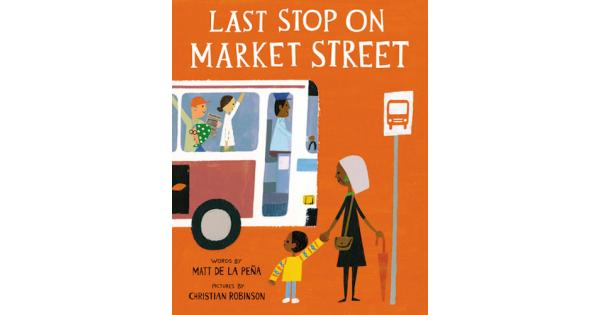
Title: Last Stop on Market Street
Author: Matt La Peña
Illustrator: Christian Robinson
Awards: Newbery Medal, Caldecott Honor, Coretta Scott King Illustrator Honor Book, New York Times Book Review Notable Children’s Book, etc.
Book Focus: Realistic Fiction, Picture Book

When Matt La Peña was a child he struggled in school and with reading. Basketball was his main interest and he went to the University of the Pacific on a full athletic scholarship. While there he fell in love with literature, which changed his life. He is now an award winning author and has written young adult books and children’s books. Many of his books deal with the themes of race and sports. In addition to his writing, he also teaches creative writing and speaks at schools.
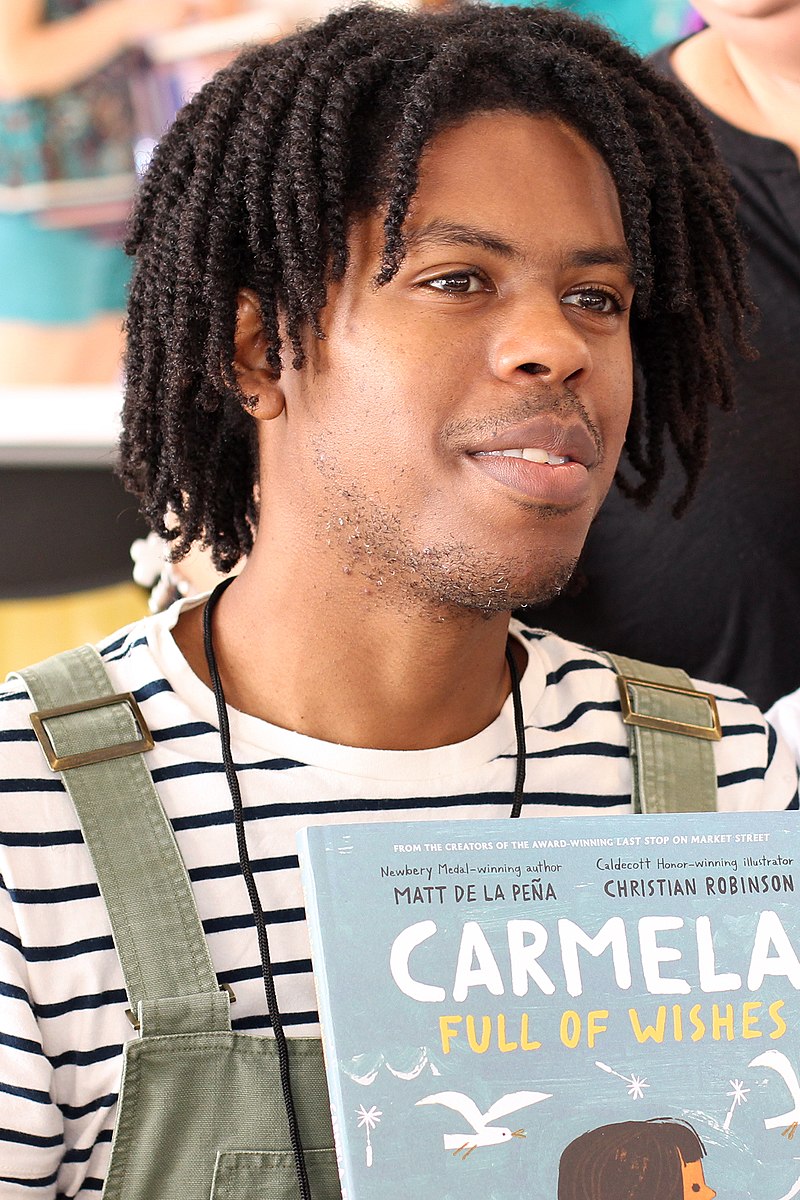
Christian Robinson began his career as an animator after graduating from animation school. A children’s book agent noticed his art on his blog and asked Christian if was interested in making children’s books. Christian has now illustrated several children’s books and recently released his first book as author and illustrator. He is known for his bold and classic style.
Last Stop on Market Street is a simple, yet profound story about a young boy named CJ and his grandmother. They board the bus for Market Street after church on a Sunday. CJ questions why they take this trip every Sunday and seems to wish he could go play. His grandmother, however, helps him to notice the beauty and value in the people on the bus with them and the neighborhood and places around them. They depart the bus in a rundown area and as CJ sees the people in the soup kitchen, he is glad they came to volunteer.
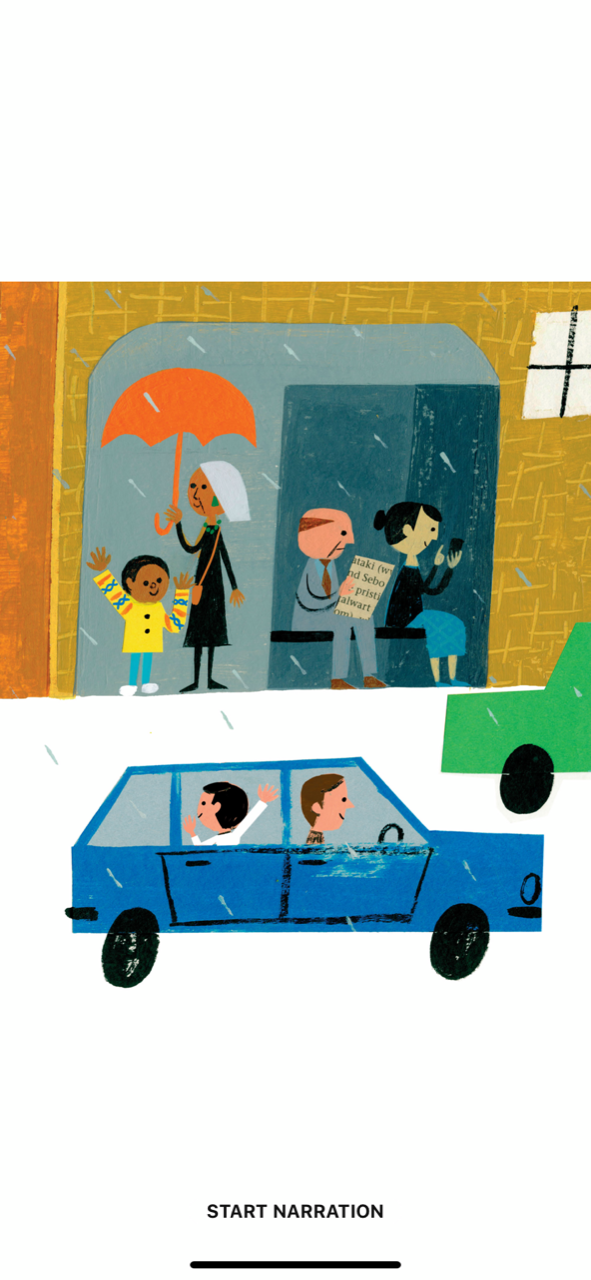
Last Stop on Market Street is a beautiful book, in both the language element and the visual element. The sweet and simple illustrations match the tender story. Christian Robinson used paint and collage elements to create the striking artwork. I love the mixture of paint and collage, especially on page six, which shows people waiting at the bus stop, complete with a man reading a newspaper with realistic looking print. Illustrations in this book play a large part in creating the setting of the book. We, as readers, feel as if we could step right into this neighborhood. The details also bring the characters to life. We notice the tattoos on a man on the bus and the earbuds of the teens listening to music. Though the illustrations are simple and almost child like, there is a lot of detail that brings realism to the setting. For example, throughout the book we see graffiti on buildings, chain link fences with barbed wire, pigeons, overflowing trash cans, and crosswalks. Robinson uses a lot of simple shapes in the illustrations. The cars, for instance, are boxy and rectangular shaped. There are many other visual uses of box-like squares and rectangles. The buildings, the bus windows, the bus itself, the tables in the soup kitchen, and the shopping cart are all ways that the shape is used to create a pleasing and bold composition.
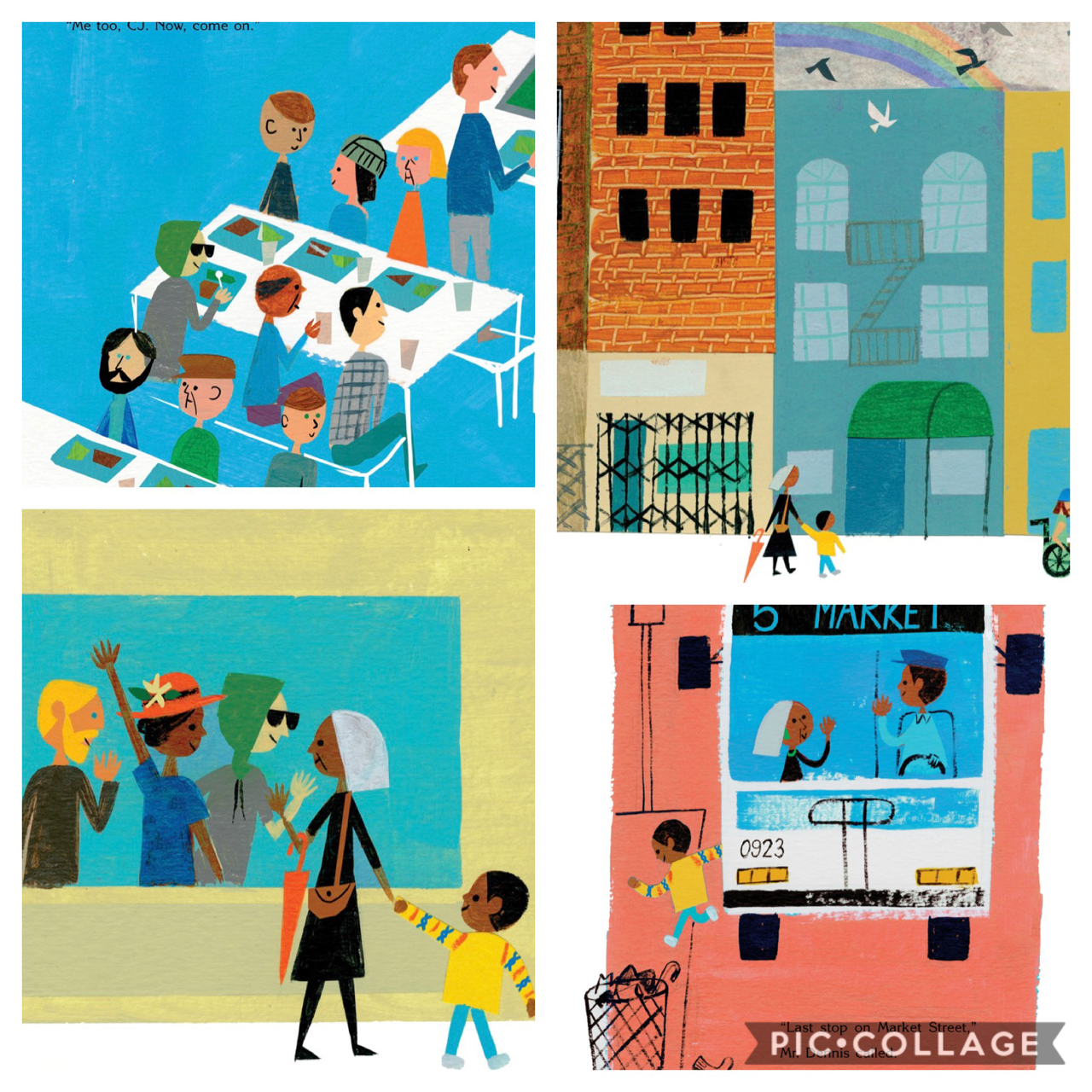
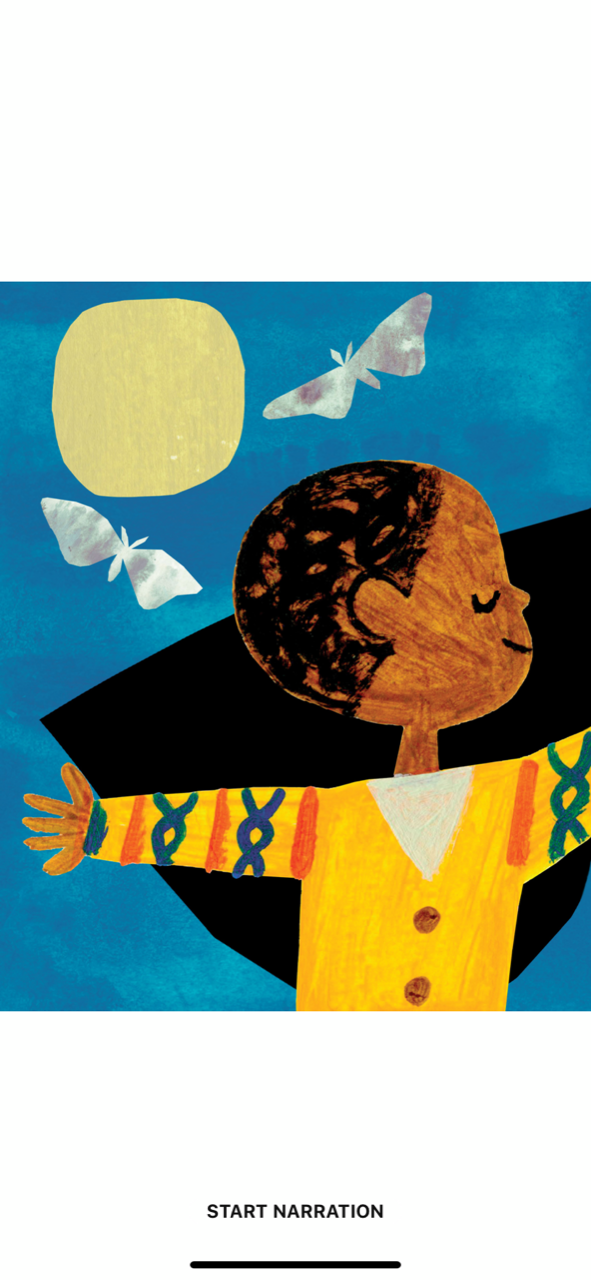
Another visual aspect of note is the setting of the mood. On page seventeen we see CJ’s reaction to the man playing the guitar. Matt de la Peña (2015) writes, “And in the darkness, the rhythm lifted CJ out of the bus, out of the busy city” (p. 17). We see CJ with eyes closed, not on the bus, but under a night sky under the moon and with birds flying by. In this picture we can feel with CJ how the music is affecting him. The mood in this scene is peaceful and serene. The mood through the rest of the book is both realistic and gritty and at the same time, cheerful. We see the rundown aspects of the setting, but the cheerful colors and bold composition keep the mood light. The mood plays an important role in the theme of finding beauty in the mundane or the bleak.
Last Stop on Market Street is an example of contemporary realistic fiction. Tunnel et al. stated that, “Contemporary realistic fiction tells a story that never happened but could have happened” (2016, p. 137). The simple plot, story line, a child as the main character, and the realism in the illustrations make this story feel like it could have happened. This story is about one common event that many people can relate to. Children could experience this book and connect with the story, or have had a similar experience on a bus, at a soup kitchen, or going somewhere with a grandparent. Last Stop on Market Street could be classified in the School and Family category of Realistic Fiction (Tunnel, et al. 2016). There isn’t necessarily a problem to be solved, but more of an experience with family and a lesson learned. This books is also an example of wonderful writing. Tunnel et al. stated that, “The difference between providing sensory detail and generalizing is the difference between showing and telling” (2016, p. 25) For example, de la Peña wrote,”it also smelled like the rain, which freckled CJ’s shirt and dripped down his nose” (2015, p. 2). This book is also an example of revealing truth and insights (Tunnel, et al, 2016). Nana said to CJ, “Sometimes when you’re surrounded by dirt, CJ, you’re a better witness for what’s beautiful” (de la Peña, 2015, p. 22). Though a simple story with simple illustrations, Last Stop on Market Street is a touching, insightful book.
References
- Tunnell, M. O., Jacobs, J. S., Young, T. A., & Bryan, G. (2016). Children’s literature, briefly (6th ed.). Upper Saddle River, NJ: Pearson.
- de la Peña, M. (2015). Last stop on market street. New York, NY: G.P. Putnam’s Sons.
- https://mattdelapena.com/bio/
- https://bookriot.com/2019/03/28/christian-robinson-interview/
- https://en.wikipedia.org/wiki/Matt_de_la_Peña
- https://en.wikipedia.org/wiki/Christian_Robinson

 Between the Trees
I loved your mentioning of the subtle, yet intentional details in Last Stop on Market Street. The tattoos, graffiti, etc. included in the illustrations definitely support realism, as you mentioned, but I don’t think I said so or commented on this directly in my own post, so I appreciate you pointing that out!!
LikeLike