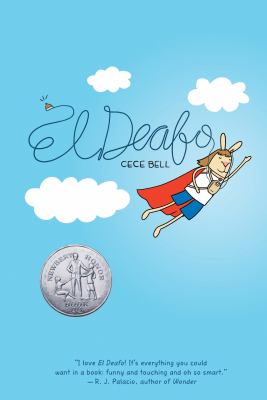
Title: El Deafo
Author/Illustrator: Cece Bell, color by David Lasky
Awards: John Newberry Award, Eisner Award
Book focus: Partial biography, graphic novel
Cece Bell is an author and illustrator of several books, including the Sock Monkey series, Rabbit and Robot, and El Deafo. She was born in Richmond, Virginia and has degrees from the College of William and Mary and Kent State. She wrote the award winning El Deafo to chronicle her experience of hearing loss at age four and her experience of growing up deaf. She is married to well known author Tom Angleberger. She hopes to be known as, “that AWESOME author and illustrator that happens to be deaf!”
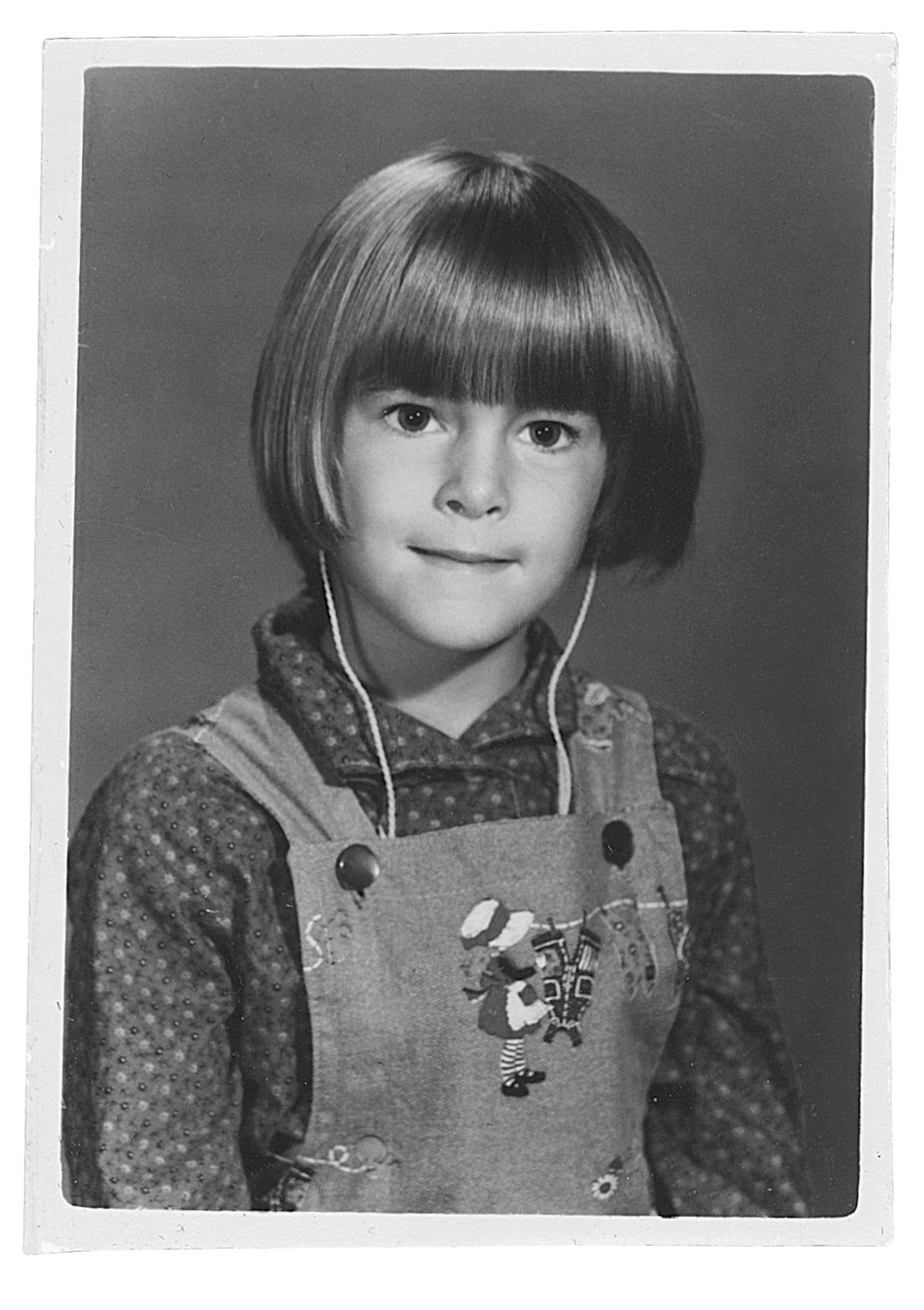
El Deafo is a partial autobiographical account of Cece Bell’s life from the age of four until the age of eleven. When she was four years old, Cece Bell lost her hearing after being ill with meningitis. The book details her diagnosis and process of getting hearing aids and the Phonic Ear, which she used at school, attached to a microphone that the teacher wore. The story follows Cece as she moves through elementary school and struggles to make friends, accept her differences, and advocate for the ways she does and does not want to be treated as a deaf person.
Cece Bell was already a published author and illustrator when she wrote her autobiographical book, El Deafo. This work falls under two categories of biographical text, both the category of people from the arts and autobiographies (Tunnel, et. al, 2016). She began writing a blog that included stories and feelings about being deaf after a frustrating interaction with a cashier in a store. She had not been very open about being deaf before this point in her life. The blog eventually led to her writing this book. She wrote El Deafo in order to share her personal story (she points out that not all deaf people have the same feelings, attitudes, or experiences) and as a way to inform hearing people how to respectfully treat and interact with people with hearing loss. The last few pages of the book include a note from the author describing many aspects of the deaf community and how she has chosen to integrate into that community.
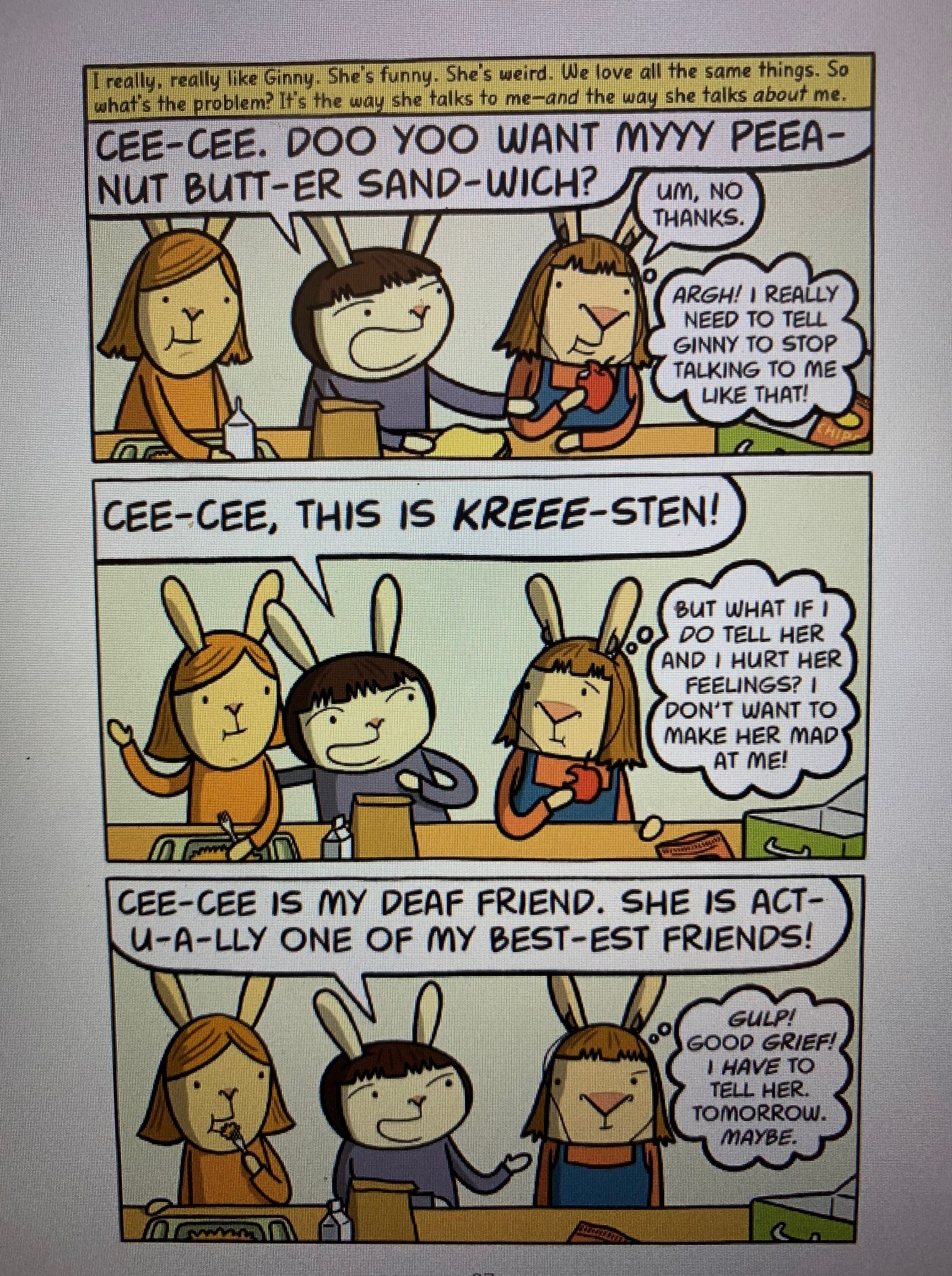
There are many qualities in El Deafo that make it a well written book. As a graphic novel, the text is primarily comprised of dialogue and Cece’s thoughts. The writing of the dialogue helps us get to know the characters and moves the plot forward. It was stated in Children’s Literature, Briefly, “Speech reveals character. When a person’s mouth opens, truth emerges about personality, motives, desires, prejudices, and feelings” (Tunnel, et al. 2016, p. 27). This is especially true in El Deafo, in which the way other people talk to Cece reveals their thoughts and prejudices about Cece and her hearing loss. For example, her friend Ginny speaks very loudly and slowly to Cece because she assumes that will be helpful. This is, in fact, frustrating to Cece, and not the type of help she needs. Ginny’s dialogue is written in all capital letters with some letters repeated and dashes in the syllable breaks to show the slowness. The dialogue serves to demonstrate not only what the characters say, but what they think and feel, as well.
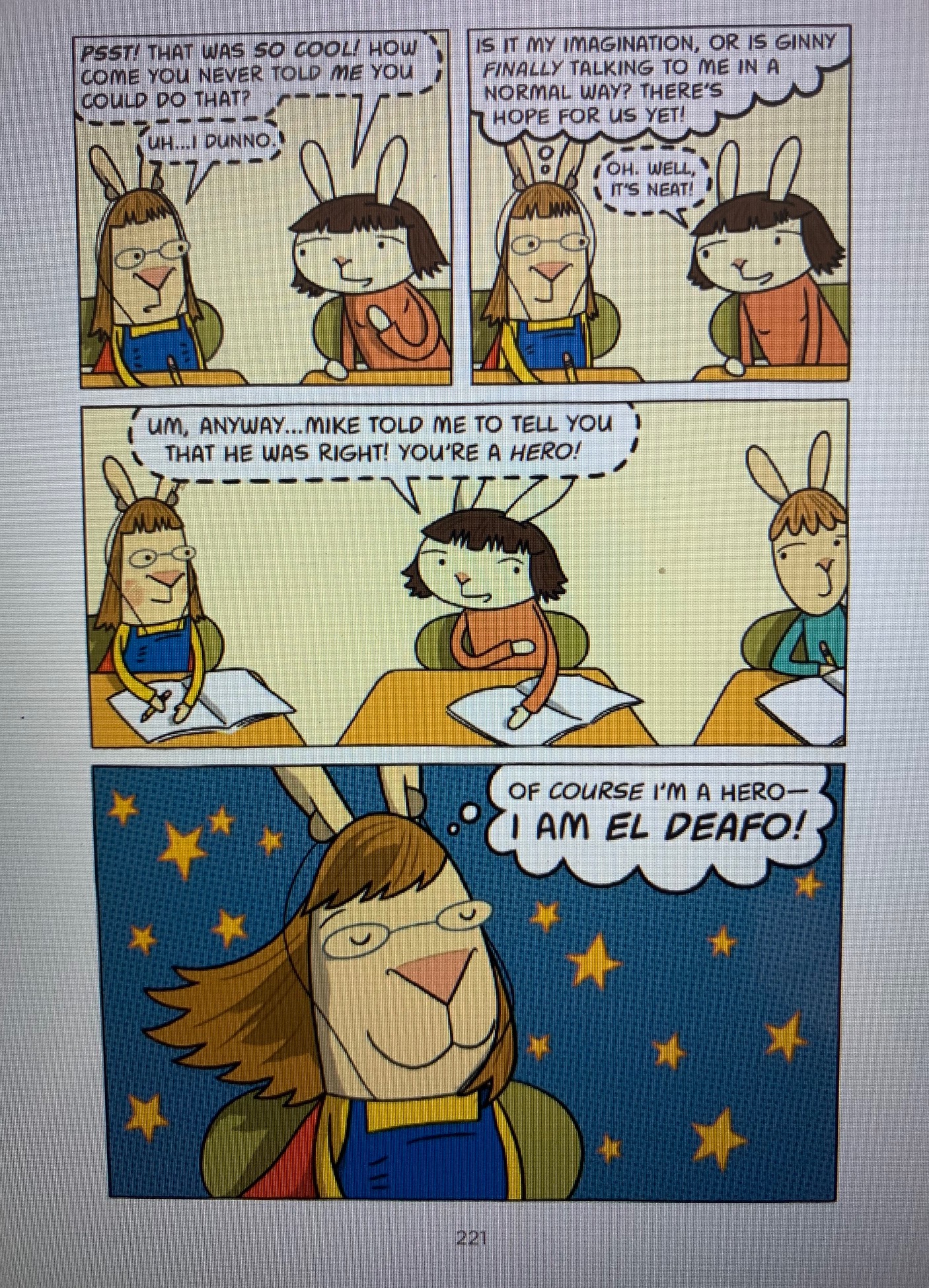
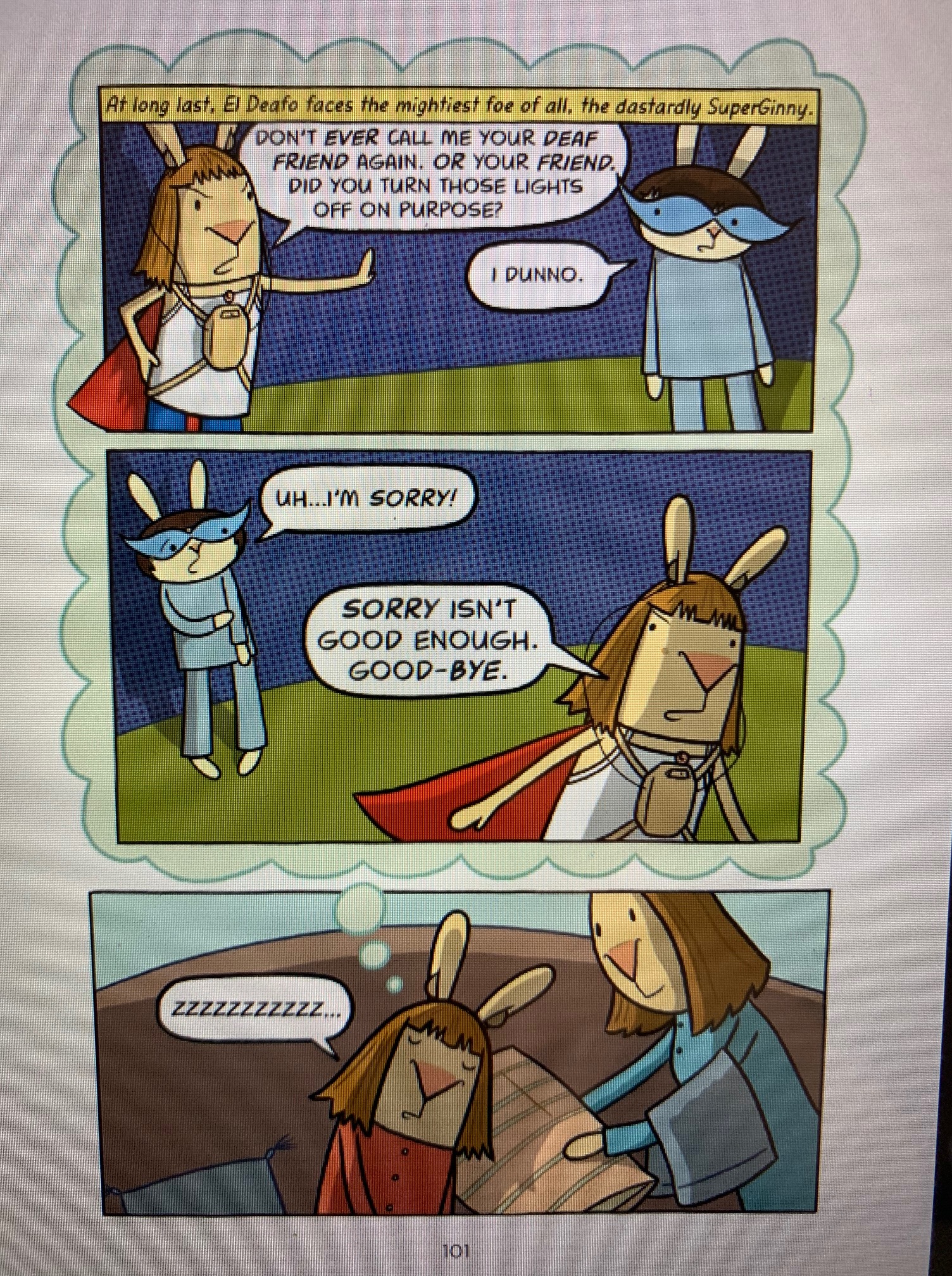
The creation of the El Deafo character serves to show us another side to Cece, the part of her that wants to be brave and say what she really thinks. El Deafo is the superhero counterpart to her character. Bell uses this as a way to reveal her character’s thoughts and desires and also to educate the reader about communication with someone who is deaf. Throughout the book we see Cece struggle to tell people how she feels and with her own acceptance of her hearing loss. She feels self conscious and different than everyone else. By the end of the book Cece has become more confident and has found acceptance in her school, her friend group, and her neighborhood. As stated in Children’s Literature, Briefly, “autobiography provides the unique viewpoint of self-revelation” (Tennel, et al. 2016, p. 171). We see Cece develop her own thoughts about friendship and deafness. The reader will interact with these themes from their own perspectives of friendship and other-ness.
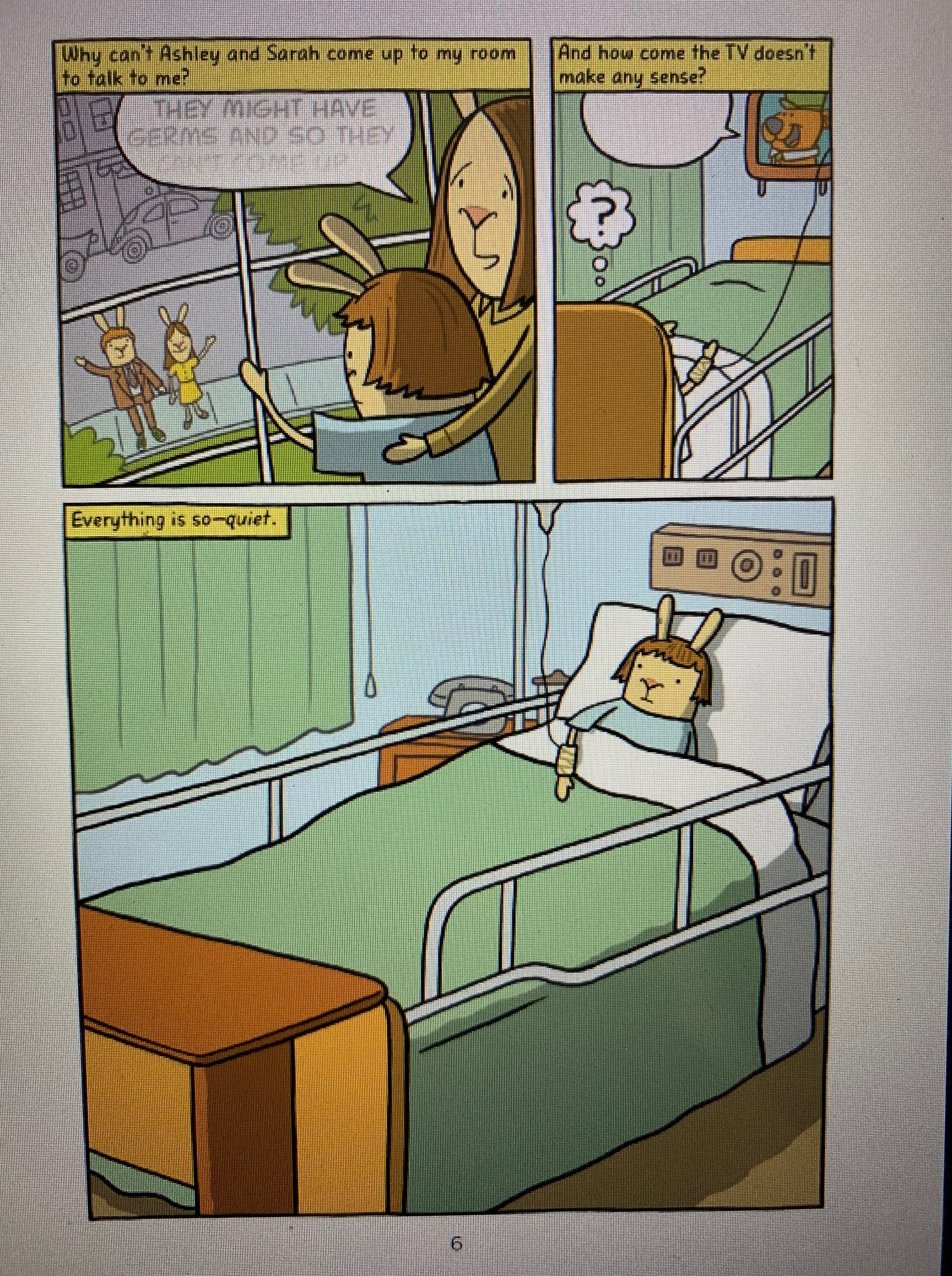
The artwork in El Deafo supports the text in several ways and impacts readers in many ways. Bell states that, “Rabbits were the perfect visual metaphor for my experience. Rabbits have big ears and amazing hearing. As the only kid in my school who was deaf, I felt like the one rabbit whose big ears didn’t work.” Visually, the rabbit makes the characters appealing to children and also represents the ostracized feelings of Cece. The use of font also plays a role in the story by revealing plot changes. For example, on page 6, Cece is in the hospital with meningitis. She is losing her hearing and the printed type in the text bubbles gets lighter as she hears less, and the subsequent text box is empty. The use of different font type for different situations increases children’s visual literacy. Students may notice that print in a bubble with a yellow background and red border is showing what Cece hears from the Phonic Ear. When someone is speaking loudly the font is large. If Cece is imagining what her counterpart, El Deafo, might do, there is a dotted background to the panel. These are patterns that children can notice that will enhance their comprehension of the story. The detail in the realistic drawings adds to the story, making it believable. Each of the characters looks different in appearance and their facial expressions add depth to the character development and plot.
Students may sympathize with Cece and feel a connection to her, or they may feel more connection to the friends and classmates, depending on their experiences. This text will elicit a variety of reactions, personal connections, and themes from students.
References
- Bell, C. (2014). El deafo. New York, NY: Amulet Books.
- Tunnell, M. O., Jacobs, J. S., Young, T. A., & Bryan, G. (2016). Children’s literature, briefly (6th ed.). Upper Saddle River, NJ: Pearson.
- https://www.theguardian.com/childrens-books-site/gallery/2015/aug/04/cece-bell-el-deafo-in-pictures
- https://en.wikipedia.org/wiki/Cece_Bell
- http://blaine.org/sevenimpossiblethings/?p=1520

 Between the Trees
I didn’t even realize that the color of the text bubble changed when she was hearing through her phonetic ear! Great observation and definitely something that will enhance children’s literacy skills. I also really enjoyed how thoughtful Bell was with her font changes and choices. I think this demonstrates to student the careful attention to detail that good writers implement in their writing. Nice work!
LikeLike