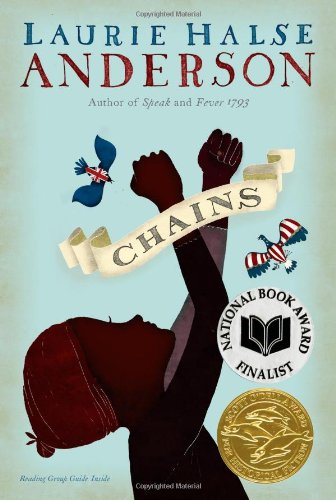
Title: Chains
Author: Laurie Halse Anderson
Awards: National Book Award finalist, IRA Teacher’s Choice, Scott O’Dell Award for Historical Fiction, Notable Children’s Book Award by Association of Library Service to Children
Book Focus: Historical Fiction

Chains was written by Laurie Halse Anderson in 2008. It tells the story of a fictional character, Isabel, during the real events of the Revolutionary War in New York. Isabel is a slave in Rhode Island who had been promised freedom, who along with her younger sister, are sold to a man and his wife in New York after their previous owner died. They arrive in New York in May 1776, just as the war is reaching its heights and tensions are high among Patriots and Tories. Isabel suffers in the house of her owners and is separated from her her sister. She escapes with her friend Curzon at the end of the book. Their story will continue in the next two books in the series.
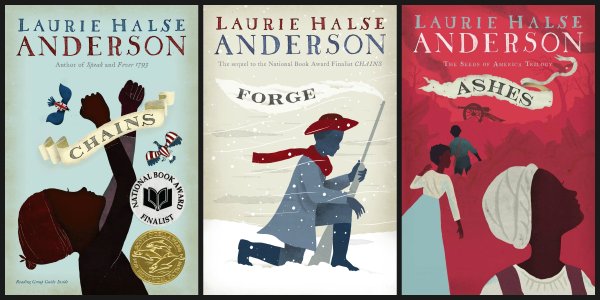
Chains is an example of historical fiction that takes place exclusively in the past and before the author and audience was living (Tunnel et al, 2016). According to Children’s Literature, Briefly, “Historical fiction is judged by the same criteria as any other piece of fiction: strength of character development, credibility of plot, quality of writing style, definition of setting, handling of theme” (Tunnel et al, 2016, p. 155-156). The skillful character development in this text creates a strong connection between the character of Isabel and the reader. As I read this book I was brought to tears by the scene of Isabel being branded. Anderson writes,
“The man pushed the hot metal against my cheek. It hissed and bubbled. Smoke curled under my nose. They cooked me. The man stepped back and pulled the iron away. The fire in my face burned on and on, deep through my flesh, searing my soul. Stars exploded out the top of my head and all of my words and all of my rememberies followed them up to the sun, burning to ash that floated back and settled in the mud.”
Chains, p. 185
The branding of Isabel holds significant symbolism in the book and also presents one of the indicators of quality historical fiction, which is that history should not be watered down (Tunnel et al, 2016). Children are not shielded from realistic examples of the treatment of slaves during this time period. Madam, the wife of the home, treats Isabel and her sister poorly and renames Isabel as Sal. The branding is punishment for her anger in hearing that her sister has been sold. Isabel yells at Madam, calling her a rude name and running away after Madam strikes her with a painting. The branding is meant to make Isabel feel shame and to be an example to other slaves, but Isabel is able to find strength in her scar. The letter I that has been branded into her cheek is meant to stand for insolence, but to her it stands for Isabel, her true name and her true self. She also connects the brand to her father, who had three scars on his face. The scar is symbolic of overcoming adversity, finding strength within yourself, and family connections. She says near the end of the book,
“I turned my head to the side a bit and studied the brand on my face; for the first time, studied it hard: the capital “I” that proclaimed my insolent manners and crimes. I leaned over closer to the mirror. The letter was a pink ribbon embroidered on my skin. I touched it, smooth and warm, flesh made into silk. The scars on Poppa’s cheek had been three lines across his cheek, carved with a sharp blade. He was proud of his marks. In the country of his ancestors, they made him into a man. I traced the “I” with my fingertips. This is my country mark. I did not ask for it, but I would carry it as Poppa carried his. It made me his daughter. It made me strong. I took a step back, seeing near my whole self in the mirror. I pushed back my shoulders and raised my chin, my back straight as an arrow. This mark stands for Isabel.”
Chains, p. 355
We become connected to Isabel in this book, and we see the historical events through her eyes, another marker of quality historical fiction (Tunnel et al, 2016).
Another trademark of quality historical fiction is presenting multiple perspectives (Tunnel et al, 2016). Chains provides insight into both the Loyalists’ and the Patriots’ feelings and views on the colonists’ independence. We see these viewpoints through the characters that Isabel interacts with, and we see how her own thoughts change back and forth throughout the book as she tries to decide which side is more likely to help her. This aspect lends itself well to transactional theory, whereby the reader will bring their own schema and cultural ideas to the text and may create their own meaning of the text. Readers, depending on their own experiences, may have various thoughts about the colonies’ rebellion from the king. The readers may also have a variety of reactions to Isabel. Teachers may ask their students to consider questions like, Should Isabel have done something different to assert her freedom before being sold to the Locktons in New York? Should Isabel have tried to run away earlier? Should Isabel have become a spy for the Patriots? Why did Isabel stop speaking for a while after being branded? Should Jenny or Lady Seymour tried harder to keep Isabel and Ruth from living with the Locktons? What do you think you might have done in each of these situations? Students might have more than one idea about the main theme of the book, and should be encouraged to share their ideas.
I would rate Chains as a high quality historical fiction novel. There are valuable themes of justice, equality, and personal strength, The setting and events of the time period are accurately portrayed and help the reader understand the events of history and feel as if they are there alongside the characters. The attempted assassination of George Washington, the pamphlet Common Sense, and the fire in New York City are accurately portrayed, but through Isabel’s eyes. The characters are believable and relatable, and the complexity of the issues of the historical events are explored in depth. The language is beautiful, almost poetic. I love Isabel’s use of the word “rememberies” for memories, because it is endearing and sweet. Several times I re-read a sentence or paragraph to appreciate the imagery and figurative language. One example is on page 184, when Isabel thinks, “I fought against the tears and lost; they fell tot he dust in big drops, too. If I cried a river, maybe I could swim away, or slip under the water to freedom.” The novel Chains meet all the requirements needed to be named a top historical fiction book.
References
Anderson, L. (2008). Chains. New York: Simon & Schuster.
Tunnell, M. O., Jacobs, J. S., Young, T. A., & Bryan, G. (2016). Children’s literature, briefly (6th ed.). Upper Saddle River, NJ: Pearson.

 Between the Trees
Hi Erin,
After Week #1, my one comment will briefly address all of your posts about the anchor books.
I really like your observations about how the autobiography presented in El Deafo is enhanced through the visuals and the visual elements, including the variations on the speech bubbles (thought bubble and super hero speech bubbles). And, as you note, the bunny ears draw the reader’s attention to the collection of experiences and feelings. Also, we can easily connect with Cece as we share her feelings of confidence, fear, struggles, and bravery during the book. And, as you mention, we can easily empathize with her hearing issues as well as the typical struggles of adolescence.
I appreciate your observations of the water color and collage visuals linked to the transformation of Troy’s character in Trombone Shorty from little boy to adult musician. Your description of how the illustrations transport the reader to Troy’s neighborhood and culture is rich! And, you’re right on target, the attention to detail is amazing!
In Chains, you focus on the branding scene and how Isabel survives, even advances afterward seeing the “I” branded on her face as part of her identity and name, Isabel. We DO become connected to Isabel and move through each struggle “with her” and hoping for her ultimate freedom. Also, you highlighted some key features of Chains that make is a quality historical fiction book; accuracy, no sugar coating, a historical event told through the perspective of the main character who can bring the event “to life.”
I hope you enjoyed these Week #2 books as well as the books for Week #3.
Sherry Taylor
LikeLike