Title: Trombone Shorty
Author: Troy “Trombone Shorty” Andrews
Illustrator: Bryan Collier
Awards: Caldecott Honor Book, Coretta Scott King Illustrator Award
Focus of Book: Autobiographical Picture Book
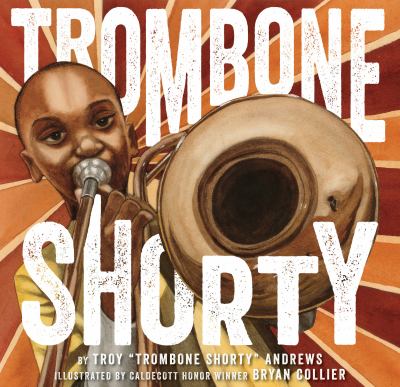
Trombone Shorty is an engaging autobiography of Troy Andrews, a musician born and raised in New Orleans. He began playing the trombone at age four and has had a very successful music career. He and his band, Trombone Shorty & Orleans Avenue, have played with many well known artists all over the world and performed on television shows and at the White House.
Bryan Collier is an award winning illustrator. He was born and raised in Maryland and became interested in art as a young child. He was influenced by the illustrations in books like The Snowy Day and Harold and the Purple Crayon. He won a scholarship to Pratt Institute in New York and graduated with honors. His art has been displayed at the Capitol Building in Washington D.C. It took him many years to have his first book, Uptown, published. When Bryan isn’t making writing and illustrating children’s books, he volunteers at the Harlem Hospital Center and visits schools.
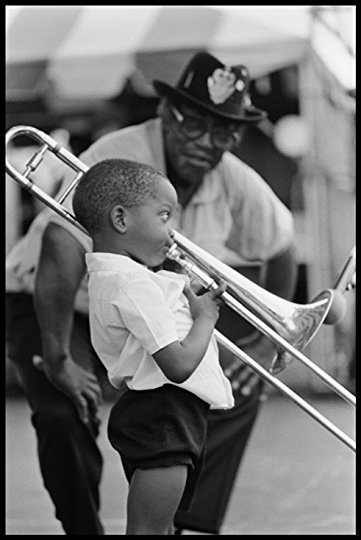
Troy Andrews was born and raised in New Orleans. Music played a very important role in his neighborhood, especially around the time of Mardi Gras. Brass bands would parade through the streets. Troy really wanted to be able to play music, too. One day, when Troy was four years old, he found an old broken trombone and began playing. He earned the nickname “Trombone Shorty” because he was so small compared to the size of the trombone. He and his friends created their own band with homemade and broken instruments. When he went to a Bo Diddley concert with his family, he brings his own trombone and plays along from the crowd. Bo Diddley asks him to play up on the stage with him, and Trombone Shorty’s career is born. He continues playing and practicing and becomes a world renown musician.
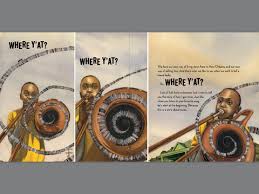
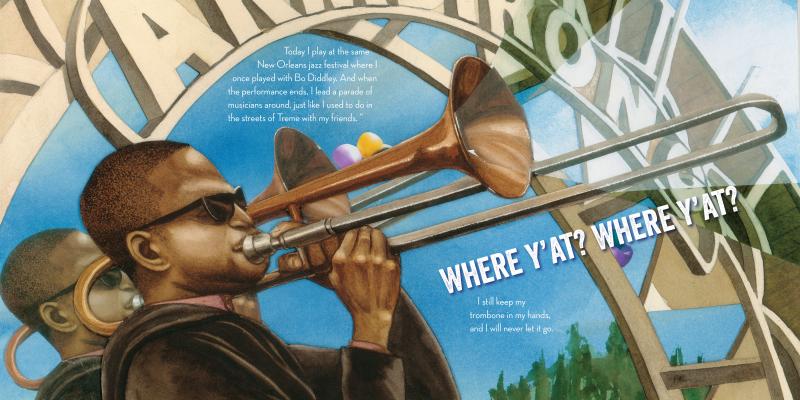
There are several features of the art in this book that promote visual literacy. The paintings are realistic and bold. The use of line and color draws the reader in and captures the reader’s interest. The spiraling lines on pages one and two are examples of leading lines. The layering of the collage elements give the art more texture and depth, which adds meaning to the text. The illustrations in Trombone Shorty transport the reader to New Orleans, to the neighborhood that Troy Andrews grew up in. We are reading about the events of young Troy’s life, but we are also immersed in his culture, his family’s way of living, and the social construct of his neighborhood. We see glimpses of his kitchen, his bedroom, and the streets he lives on. The attention to detail adds to the realism of the text and the art.
The use of font type and size and composition are another aspect of visual literacy. The phrase “Where y’at?” is an important part of the culture and is emphasized with big, bold print, and either black or white colors. On the last page of the book the phrase, “Where y’at?” is placed right under the lines of the trombone slide, creating interesting composition. Collier makes use of composition to draw attention to important aspects of the story. By painting Trombone Shorty and his trombone larger than the other parts of the illustration the reader is drawn to the. As stated in Children’s Literature, Briefly, “Artists can ensure that certain shapes are dominant by making them larger or brighter to attract the eye” (Tunnel et al, 2016, p. 43).
Readers approach the text of Trombone Shorty from their own individual perspectives based on their backgrounds and experiences. The text is inviting the reader into a particular time and place, and the reader is bringing their own cultural experiences to interact with this time and place. Students in a classroom may or may not have experience with jazz music, the trombone, Mardi Gras parades, or the culture of New Orleans. They might, however, make connections to the concepts of desiring to do something, finding a way to accomplish it, and being dedicated to something. Teachers can invite a response from students by asking for initial impressions to the book and then asking some guiding questions about students’ connections to the text and illustrations. Why didn’t Troy’s family just go buy a trombone for him? Why is music important to people? Have you been affected by music? Who else can you think of that has worked toward a goal for their whole life? How did Trombone Shorty’s community help him reach his goal? It might be possible to read Trombone Shorty with an efferent approach, such as reading in order to gather facts about Troy Andrews’ life, but it lends itself more to an aesthetic approach. The illustrations and the written text are almost like music, and the reader is affected by the feelings, memories, and ideas that the book conjures. The interplay between the words and the art create an experience, which might be different for each reader.
References
- Andrews, T. (2015). Trombone shorty. New York: Abrams Books for Young Readers.
- Tunnell, M. O., Jacobs, J. S., Young, T. A., & Bryan, G. (2016). Children’s literature, briefly (6th ed.). Upper Saddle River, NJ: Pearson.

 Between the Trees
Erin,
I very much enjoyed your blog about Trombone Shorty. I thought you did a really great job of articulating the components utilized within the illustrations. When you said, “Students in a classroom may or may not have experience with jazz music, the trombone, Mardi Gras parades, or the culture of New Orleans. They might, however, make connections to the concepts of desiring to do something, finding a way to accomplish it, and being dedicated. ” it made me think how fun it could be to introduce your student to the culture and bring some music into the classroom in connection to this text!
Lauren Eddleman
LikeLike