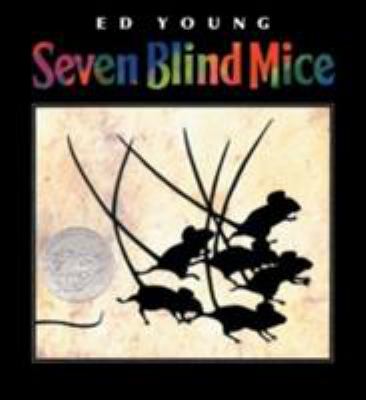
Title: Seven Blind Mice
Author/Illustrator: Ed Young
Awards: Caldecott Honor
Focus of Book: Fiction picture book
Overview of Author/Illustrator:
Ed Young is an author and illustrator of many books. His childhood was spent in Shanghai and Hong Kong, and he came to the United States as a young adult to study art. He is inspired by Chinese painters and philosophers.
Book Summary:
A group of seven blind mice try to determine the identity of a new and large object near their home. Each mouse discovers a different aspect of the object, and they argue about what the object is until the last mouse figures out that all the aspects add up to be different parts of an elephant.
While The Seven Blind Mice does have elements of counting books and also emphasizes the concept of color and sequencing, I find this book to be more of a Picture Storybook. As stated in Children’s Literature, Briefly, “The Hallmark of the picture storybook is that text and illustrations work together to tell a story” (Tunnel, et al, 2016, p. 76). The intent of the author is to retell a classic fable in a contemporary fashion. The book is a fun and enjoyable way to experience this fable and think about the concept of seeing the big picture in life and seeing things from many perspectives.
The Seven Blind Mice incorporates numerical vocabulary, such as “first,” “second,” and “third,” but does not include a visual representation of numerals or repetitive counting. This book could meet the definition of a “better counting book,” (Tunnel et al, 2016, p. 71) because is allows for the discovery of a larger concept and has high quality illustrations.
Analysis of Visual Elements:
This book is striking in part because of its use of color. Every page is comprised of a black background with a white border. The text is white, and the mice and other objects are bright and mostly primary colors. The use of black and simple color is attention-getting, but also draws parallels to the blindness of the mice, who see only blackness. The painterly style uses impressionism, “which emphasizes light, movement, and color over detail” (Tunnel et al, 2016, p. 40). The elephant is depicted in an almost collage like way, with significant texture and layering. In many of the pages the mice are shown in a vertical line, standing on top of each other. This reinforces counting, color names, and sequencing.
The illustrations in this book are essential to story telling. We are shown part of the elephant and then an image showing what the mouse had “seen.” The reader can see the similar shapes and sizes. This helps the readers identify with the mouse who is sure of what he saw. We are experiencing the text but also what the mice experienced from their points of view.
The Seven Blind Mice is a colorful and engaging book that encourages us to look beyond ourselves and to not only see someone else’s perspective but to expand our thoughts.
References
Tunnell, M. O., Jacobs, J. S., Young, T. A., & Bryan, G. (2016). Children’s literature, briefly (6th ed.). Upper Saddle River, NJ: Pearson.
Young, E. (1992). Seven blind mice. New York, NY: Philomel Books.

 Between the Trees